

There are more AI market research platforms on the market right now than most buyers have time to evaluate properly.
Every vendor claims faster insights, smarter analysis, and a seamless end-to-end workflow. The landing pages look similar. The demo calls follow the same script. The case studies feature the same categories of results. And somewhere in the evaluation process, the team doing the buying realizes that the criteria they walked in with, speed, price, ease of use, aren't actually enough to tell the good market research platforms apart from the ones that will disappoint them six months in.
Choosing the right AI market research platform is less about finding the most feature-rich option and more about finding the one that fits how your research actually runs, what your team actually needs, and where your current process is actually breaking down.Those are different questions from the ones most vendor comparisons help you answer.
This is a guide to asking the right ones.
Start with Where Your Current Process Breaks Down
Before evaluating any market research platform, it's worth being honest about where your current research workflow actually fails you.
Is the problem speed? Studies that take six weeks when the business needs answers in six days. Is it cost? Research budgets that limit how often you can go to market with a study. Is it quality? Data that comes back with gaps, inconsistencies, or open-ended responses that nobody has time to analyze properly. Is it scale? The inability to run research continuously rather than project by project.
The reason this matters is that different platforms solve different versions of the problem. A platform built primarily around fast survey deployment solves a speed problem. A platform with a strong qualitative analysis engine solves a depth problem. A platform with integrated sampling and real-time quality monitoring solves a data quality problem. Buying the wrong solution for the problem you actually have is how you end up with a platform nobody uses after the first quarter.
Understand What "AI-Native" Actually Means
Most research platforms calling themselves AI tools today fall into one of two categories, and the difference matters more than the marketing suggests.
The first category: platforms that added AI features on top of an existing survey or research tool. You might see this as an AI-powered report summary, a chatbot interface for querying your data, or automated crosstab generation bolted onto a traditional survey platform. These are genuinely useful additions. They're not AI-native research.
The second category: platforms built from the ground up around AI, where the AI is doing substantive work at every stage of the research lifecycle. Questionnaire design informed by methodology training, not just templates. Real-time data quality monitoring during fieldwork, not post-field cleanup. Analysis that processes structured and unstructured data simultaneously, not sequentially. Outputs that go directly into decisions, not into decks that need manual translation.
The practical test is simple: ask any AI market research platform you're evaluating to show you where AI is doing work that a human researcher would otherwise have to do manually. If the answer is limited to report summarization and basic visualization, you're looking at a traditional platform with AI features, not an AI research platform. That distinction affects what you can actually do with it and how much of your manual bottleneck it removes.
Evaluate the Research LLM, Not Just the General AI
This is the evaluation step that most buyers skip and most vendors hope you will.
General-purpose AI is good at many things. It is not specifically trained on market research methodology, respondent behavior, questionnaire design principles, or the particular way customers express satisfaction, frustration, and intent in survey language. A platform running a general large language model on your research data will produce outputs that look reasonable and may not hold up when a methodologist looks closely at them.
A market research platform with a dedicated research LLM, one trained on thousands of real studies, calibrated on how respondents actually answer questions, and built to understand the difference between a genuine theme and a low-frequency outlier, produces outputs that a senior researcher would stand behind.
The questions to ask in any evaluation:
What was the model trained on, and how much of that training data came from real market research studies? How does the model handle ambiguous or contradictory responses? Can it explain why it classified a theme as significant rather than just asserting that it is? How does it perform on your specific research category, not just on a generic demo dataset?
A vendor that can't answer these questions clearly is probably running a general model with research-flavored prompting layered on top. That's a meaningful difference from a genuine research LLM, and it shows up in the quality of the outputs when you're working with real data on real research questions.
Check the Full Research Lifecycle, Not Just the Analysis Layer
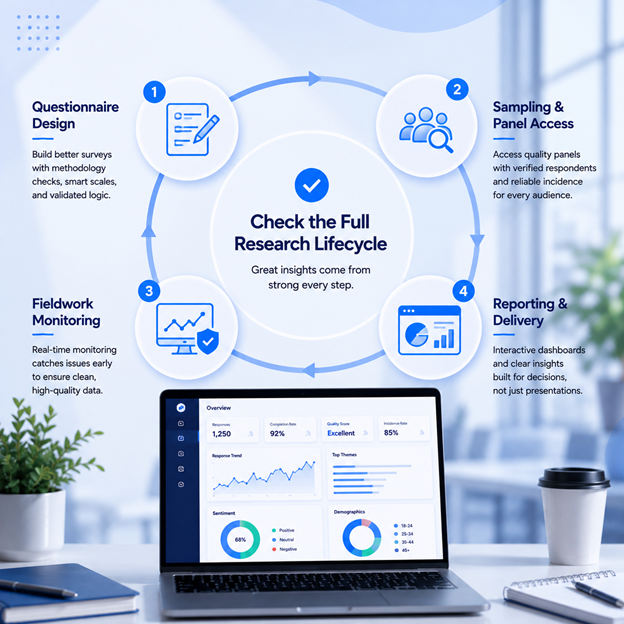
A lot of AI research platforms are strong at one stage of the research lifecycle and thin everywhere else. Analysis is the stage where most of the AI marketing focuses because it's the most visually impressive to demo. It's not the only stage that matters
Run each market research platform you're evaluating against the full workflow:
Questionnaire design: Does the platform help you build a better survey, or does it just help you build one faster? A platform with genuine methodology capability will flag double-barreled questions, suggest appropriate scale formats, identify leading phrasing, and validate routing logic. A platform that generates questions quickly without these checks speeds up a process that still produces bad instruments.
Sampling and panel access: Where does the sample come from? How is quality controlled at the recruitment stage? What incidence rates does the platform support for specialist audiences? A platform with strong analysis but weak sampling gives you great tools for analyzing data you can't reliably collect.
Look at What Happens When Something Goes Wrong
Every platform looks good in a demo on a clean dataset with a cooperative audience. The useful evaluation question is: what happens when the study doesn't go according to plan?
What does the market research platform do when fieldwork quality drops below acceptable thresholds mid-study? How does it handle a low incidence audience that's harder to recruit than expected? What support does it provide when the analysis produces findings that require methodological interpretation?
These are the questions that reveal whether a platform is built for how research actually works or for how research works when everything goes smoothly. Most research projects hit at least one complication. The platform that handles complications with built-in tools and responsive support is a different value proposition from one that performs well only on straightforward projects.
Ask vendors for examples of how their platform handled a study that ran into problems. How they answer, and whether they have specific examples rather than general reassurances, tells you a lot.
Match the Platform to Your Team's Research Maturity
Not every research team needs the same platform. A team of one running two studies a month has different requirements from an insights function running 200 studies a year across multiple markets.
Smaller, less frequent research programs need market research platforms that are fast to deploy, don't require deep technical setup, and produce outputs that non-specialist stakeholders can understand and use. The priority is accessibility and speed.
Larger, more complex programs need platforms with robust sampling infrastructure, multi-market capability, advanced analytical options, and the ability to integrate research outputs with other data systems. The priority is depth, reliability, and scale.
Be honest about where your team sits on this spectrum. A platform built for enterprise-scale research programs will have capabilities a smaller team doesn't need and a learning curve that slows them down. A platform optimized for speed and simplicity will hit ceilings that a larger program will encounter quickly.
The right market research platform scales with you rather than requiring you to migrate when your needs grow. Ask vendors directly: at what point do teams outgrow this platform, and what does the path forward look like when they do?
Run a real study, not Just a demo
The only reliable way to evaluate an AI market research platform is to run a real piece of research on it before committing.
Most vendors will offer a trial, a pilot study, or a proof-of-concept engagement. Take it seriously. Use a real research question, not a throwaway test. Bring a study that represents the kind of work you actually need to do, whether that's a large quantitative tracker, a qualitative deep-dive, or a quick concept test. Measure the output against what your current process produces and be specific about where the platform added value and where it didn't.
Pay attention to the experience of running the study, not just the output at the end. Was the questionnaire design process faster? Did the data quality feel more reliable? Was the analysis output something your team could act on directly, or did it still require significant manual work? Did the platform surface anything in the data that your current process would have missed?
The answers to those questions are more useful than anything a sales cycle will tell you.
Frequently Asked Questions
1. How is an AI market research platform different from a traditional survey tool?
A traditional survey tool helps you collect data. An AI market research platform is built to run the full research lifecycle, from questionnaire design through sampling, fieldwork quality monitoring, analysis, and reporting, with AI doing substantive work at every stage rather than just one. The practical difference is that a traditional tool requires significant human effort at every stage outside of collection. An AI platform reduces that effort across the board, which compresses timelines and reduces the cost per study.
2. What should I prioritize if I have a limited evaluation budget?
Focus the evaluation on the stage of the research process where your current workflow breaks down most consistently. If speed is the main problem, test how fast the platform moves from brief to fieldwork. If data quality is the main problem, test the real-time monitoring and how clean the dataset looks coming out of field. If analysis is the main problem, test the output quality on a study type similar to what you run regularly. Trying to evaluate everything equally spreads the evaluation too thin to produce a clear comparison.
3. Is a purpose-built research LLM really better than a general AI model for market research?
Yes, for the specific tasks that matter in research. General models produce plausible outputs on research tasks. A model trained on real research data, calibrated on how respondents actually answer questions, and built to understand questionnaire methodology produces outputs that hold up to scrutiny from an experienced researcher. The gap is most visible on the tasks where general models struggle: reading emotional subtext in survey language, distinguishing genuine themes from noise, and flagging methodology problems in questionnaire design.
4. How long does it typically take to see value from a new platform?
Most teams see meaningful time savings on the first study they run on a capable platform, primarily from faster questionnaire design and faster analysis. Deeper value, the kind that changes how your team thinks about what research can do for the business, typically takes two to three studies to fully surface. That's enough time to see how the platform performs across different study types and to identify where it adds the most value in your specific workflow.
InsignAI is a full-stack, AI-native market research platform with a dedicated Market Research LLM, built for research teams who need speed, quality, and depth without choosing between them.