

There was a time when market research was something you did before you made a decision. You identified a question, commissioned a study, waited for the results, and then acted. The decision cycle was built around the research cycle, and both of those moved at roughly the same pace.
That world is largely gone. Markets move faster now. Consumer sentiment can shift in a day. A competitor can launch and gain traction before a traditional study has even finished fieldwork. The organisations that are best positioned today are the ones that have found ways to keep pace, and increasingly that means using AI to make real-time market research happen in something close to real time.
This piece explores what real-time market research with AI actually involves, why it matters for market intelligence, and what it takes to do it well.
What Real-Time Market Research Actually Means for Market Intelligence
The phrase real-time is used loosely in many contexts, so it is worth being specific about what it means in real-time market research. It does not mean that insights are produced at the exact moment data is collected, though in some applications that is close to true. It means that the gap between data collection and insight generation is compressed dramatically compared to traditional approaches.
Where traditional research might take weeks or months from fieldwork to findings, real-time market research approaches can produce usable market intelligence in hours or days. For fast-moving decisions, this difference is not just a matter of convenience. It can be the difference between acting on a trend and reacting to one after it has already passed.
AI makes this possible by handling the data processing and initial analysis work that used to require significant human effort. When that work is automated, the bottleneck shifts from analysis to interpretation, and experienced researchers can focus their energy on the part of the process that genuinely requires human judgment.
The Data Sources That Feed Real-Time Market Research and Market Intelligence
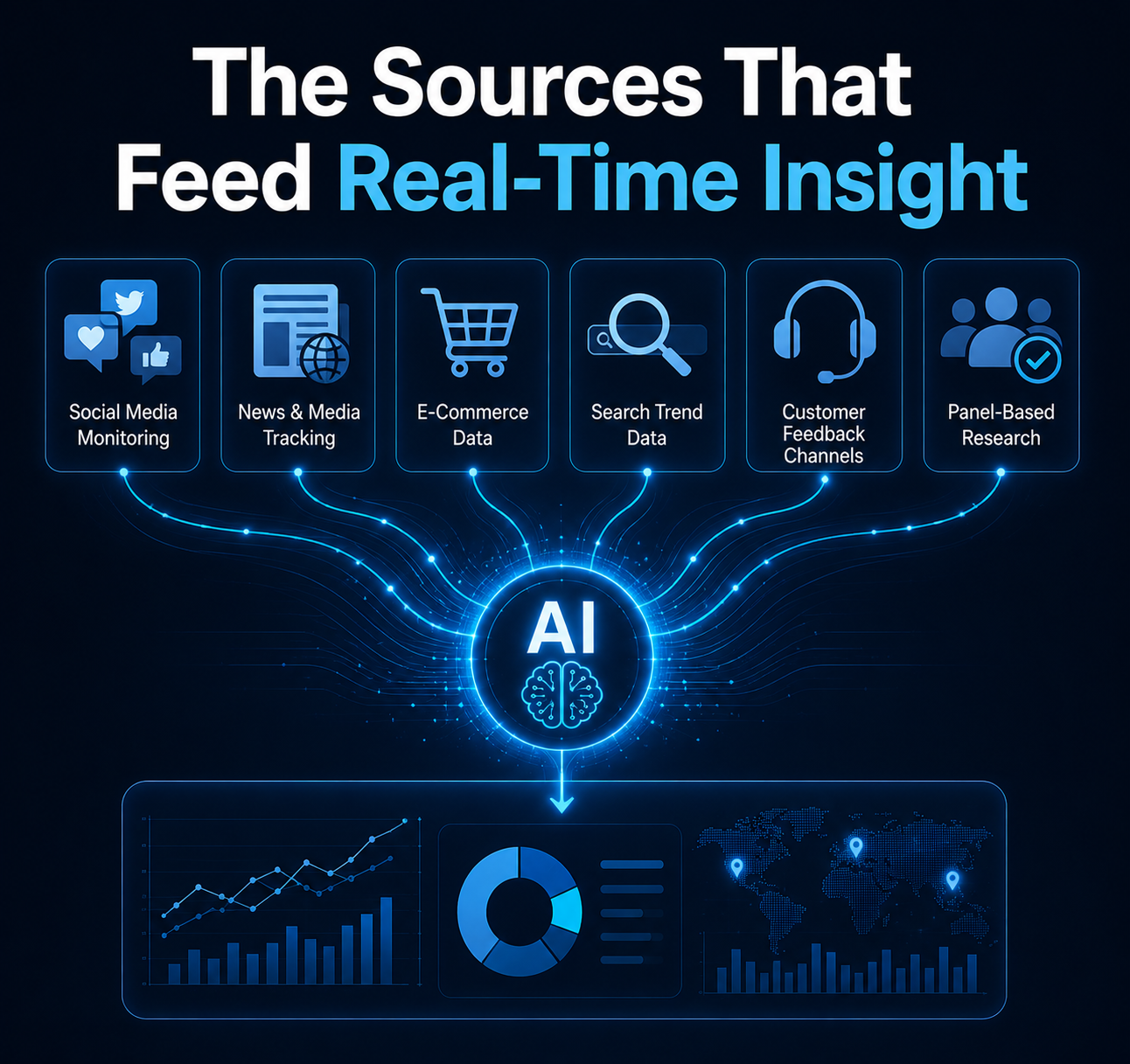
Real-time market research draws on a variety of data sources, and part of its power comes from bringing these together rather than treating them in isolation. The most commonly used sources include:
- Social media monitoring, tracking conversations, mentions, hashtags, and consumer sentiment across major platforms as they happen
- News and media tracking, monitoring coverage of brands, categories, and competitors across online publications and broadcast sources
- E-commerce data, including real-time pricing, availability, and review activity on retail platforms
- Search trend data, which can reveal shifts in consumer sentiment or concern before those shifts show up in sales or survey data
- Customer feedback channels, including reviews, support interactions, and post-purchase survey responses
- Panel-based research with faster turnaround, using digital panels that can be fielded and closed within hours rather than days
Each of these sources tells a different part of the market intelligence story. Social media reflects what people are saying publicly. Search data reflects what they are thinking privately. Sales and behavioural data reflects what they are actually doing. Combining them gives a fuller and more reliable picture of consumer sentiment than any single source could provide on its own.
How AI Processes Real-Time Market Research Data to Deliver Market Intelligence
The volume of data involved in real-time market research monitoring is well beyond what any human team could process manually. A major brand might generate thousands of social media mentions per day. A retailer might have tens of thousands of customer interactions in a week. Without AI, this data either goes unanalysed or requires large teams just to keep up with the flow.
AI addresses this through a combination of techniques. Natural language processing allows it to read and categorise text at high speed. Machine learning models can identify patterns and anomalies in consumer sentiment that would be invisible in a manual review. Automated dashboards surface the most relevant market intelligence signals and update continuously as new data flows in.
The result is that a relatively small research team can monitor a much wider information landscape than would have been possible even five years ago. They are not reading every mention or reviewing every review. They are working from AI-generated summaries and alerts that direct their attention where it is most needed.
Real-Time Market Research: Speed Without Sacrificing Quality
One concern that sometimes comes up around real-time market research is that speed comes at the cost of quality. If you are moving faster, surely you are being less rigorous? This is a reasonable worry, but it is based on a misunderstanding of where the time in traditional research actually goes.
Most of the time in a traditional research project is not spent on things that add analytical value. It is spent on logistics: recruiting respondents, managing fieldwork, cleaning data, formatting outputs. AI handles most of this automatically and, in many cases, more consistently than a manual process would.
The parts of research that genuinely require care and expertise are the design of the research question, the interpretation of findings, and the translation of market intelligence into decisions. These remain human responsibilities. If anything, compressing the operational parts of the process frees researchers to spend more time on the meaningful parts.
Practical Applications of Real-Time Market Research and Market Intelligence Across Business Functions
Real-time market research with AI is not just for research teams. It has practical applications across a range of business functions, and increasingly it is being built into how those functions operate day to day.
Product teams use real-time market research to monitor how customers are responding to launches or updates, identifying issues early enough to fix them before they become serious problems. Marketing teams use it to track how campaigns are landing, adjusting messaging based on real-time consumer sentiment rather than waiting for post-campaign analysis.
Strategy teams use market intelligence monitoring to track how rivals are positioning themselves and where they are gaining or losing ground. Customer experience teams use it to identify recurring pain points in real time rather than learning about them in a quarterly review.
In each case, the value is the same: decisions are being made with more current market intelligence, which means they are more likely to be the right decisions. The cost of being wrong, which increases when you are acting on outdated data, goes down.
The Limits of Real-Time Market Research and Consumer Sentiment Monitoring
Real-time market research is powerful, but it is not always the right approach, and it is worth being honest about that. Some research questions require depth that real-time methods cannot easily provide. Understanding why customers behave in a certain way, or exploring a genuinely new and unfamiliar topic, often benefits from the kind of careful, deliberate research that takes longer.
Real-time market research is best suited to monitoring, tracking, and detecting changes in consumer sentiment. It is less well suited to deep exploration. The smartest organisations use both, recognising that ongoing real-time monitoring and periodic in-depth research serve different purposes and answer different questions.
There is also the question of interpretation. Fast market intelligence can create an illusion of certainty that is not always warranted. A spike in negative consumer sentiment, for example, might reflect a genuine product problem or it might reflect a passing controversy that has nothing to do with the product. Experienced researchers understand how to distinguish between signals that require action and noise that does not.

Building the Right Infrastructure for Real-Time Market Research and Market Intelligence
Getting the most from real-time market research requires more than just deploying an AI tool. It requires thinking carefully about what data you want to monitor and why, how you will integrate market intelligence into decision-making processes, and what standards you will apply to determine when a signal is strong enough to act on.
Organisations that do this well tend to have a clear framework for their market intelligence work. They know which questions they are constantly trying to answer, which data sources are most relevant to those questions, and who in the organisation needs to receive which insights. Without this structure, real-time data on consumer sentiment can become overwhelming rather than useful.
Getting the infrastructure right takes time and thought upfront, but it pays off quickly. Once a well-designed system is in place, it operates largely automatically, surfacing relevant signals and allowing teams to stay informed without having to actively monitor everything themselves.
Working with Insights Curry on Real-Time Market Research and Market Intelligence
Insights Curry works with businesses that want to develop a smarter, faster approach to market intelligence. We help organisations identify the right data sources, build monitoring frameworks, and interpret the consumer sentiment signals that matter most to their strategy.
Our work combines AI-powered real-time market research analysis with experienced research thinking. We do not just hand you a dashboard and leave you to figure out what it means. We work with you to understand the questions you are trying to answer and make sure the market intelligence you are getting actually helps you answer them.
Whether you are looking to build a real-time market research monitoring capability from scratch, improve an existing approach, or simply understand how faster research could change the way your organisation makes decisions, we can help.
Frequently Asked Questions
How is real-time market research different from traditional market research?
Traditional market research typically involves a defined project with a start and end point. A study is designed, conducted, and delivered as a one-off or periodic exercise. Real-time market research is continuous, monitoring defined data sources on an ongoing basis and surfacing market intelligence as it emerges rather than at scheduled intervals.
What kinds of businesses benefit most from real-time market research and market intelligence?
Any business operating in a fast-moving environment can benefit. This includes consumer brands, technology companies, retailers, financial services organisations, and businesses in highly competitive categories. It is also particularly valuable for businesses that manage their reputation closely or operate in categories where consumer sentiment can shift quickly.
Can AI real-time market research tools work in multiple languages?
Many modern AI real-time market research tools support multiple languages, though performance can vary depending on the language and the specific application. Consumer sentiment and natural language processing tools generally work best for languages with large amounts of training data available. If your business operates across multiple language markets, it is worth checking capability carefully before committing to a specific tool.
How do you decide what to monitor in a real-time market research and market intelligence programme?
This starts with the business questions you most need to answer. What decisions do you make frequently that would benefit from more current market intelligence? What competitive dynamics do you need to keep track of? What aspects of consumer sentiment are most relevant to your product or brand strategy? Answering these questions first helps ensure that the monitoring programme is focused on things that genuinely matter.
What happens when AI flags a real-time market research signal that turns out to be misleading?
This is a normal part of working with real-time market research data. AI tools surface patterns and anomalies in consumer sentiment, but they do not always have the context to distinguish meaningful market intelligence signals from coincidental ones. That is why human judgment remains essential. A good real-time research process includes a review step where experienced researchers evaluate whether a flagged signal warrants a response before action is taken.