

Every business says it listens to its customers. Not every business actually does. The gap between saying and doing has often come down to a simple problem: there is too much customer feedback, coming in from too many places, for any team to properly process.
AI is closing that gap. Not by automating empathy, but by making it genuinely feasible for organisations to engage with customer feedback at the scale it now exists. This piece looks at how businesses are using AI to generate better customer insights, and what that actually looks like in practice.
The Customer Feedback Problem Most Businesses Have
Think about all the places customer feedback shows up. There are formal channels: surveys, product reviews, net promoter scores, customer satisfaction ratings. Then there are informal ones: social media comments, direct messages, community forums, support tickets, app store reviews, and conversations that happen in sales calls or at the point of service.
Each of these channels contains real customer insights about what customers think, what frustrates them, and what they genuinely value. But most businesses only engage with a fraction of this material in any systematic way. The rest sits unread or underanalysed, not because no one cares, but because the volume is simply too high.
AI changes the economics of this problem. It allows businesses to process large volumes of unstructured text, audio, or behavioural data and extract structured customer insights from it. What used to require a team of analysts working for weeks can now be done in hours.
Sentiment Analysis at Scale: Turning Customer Feedback into Actionable Customer Insights
One of the most widely used AI applications in customer feedback is sentiment analysis. This involves training a model to detect the emotional tone behind a piece of text, categorising it as positive, negative, or neutral, and often breaking that down by topic or theme.
For businesses that receive hundreds or thousands of reviews a week, this kind of automated sentiment analysis is genuinely transformative. Instead of asking a human to manually read through everything, an AI model can process the entire dataset, flag recurring issues, identify what customers love most, and surface anomalies that warrant closer attention.
A product team might use sentiment analysis to track how customer feedback around a specific feature shifts after an update. A service team might use it to identify the topics that most frequently lead to negative experiences. A brand team might use it to understand how perceptions are evolving over time.
Making Sense of Open-Ended Customer Feedback and Survey Responses
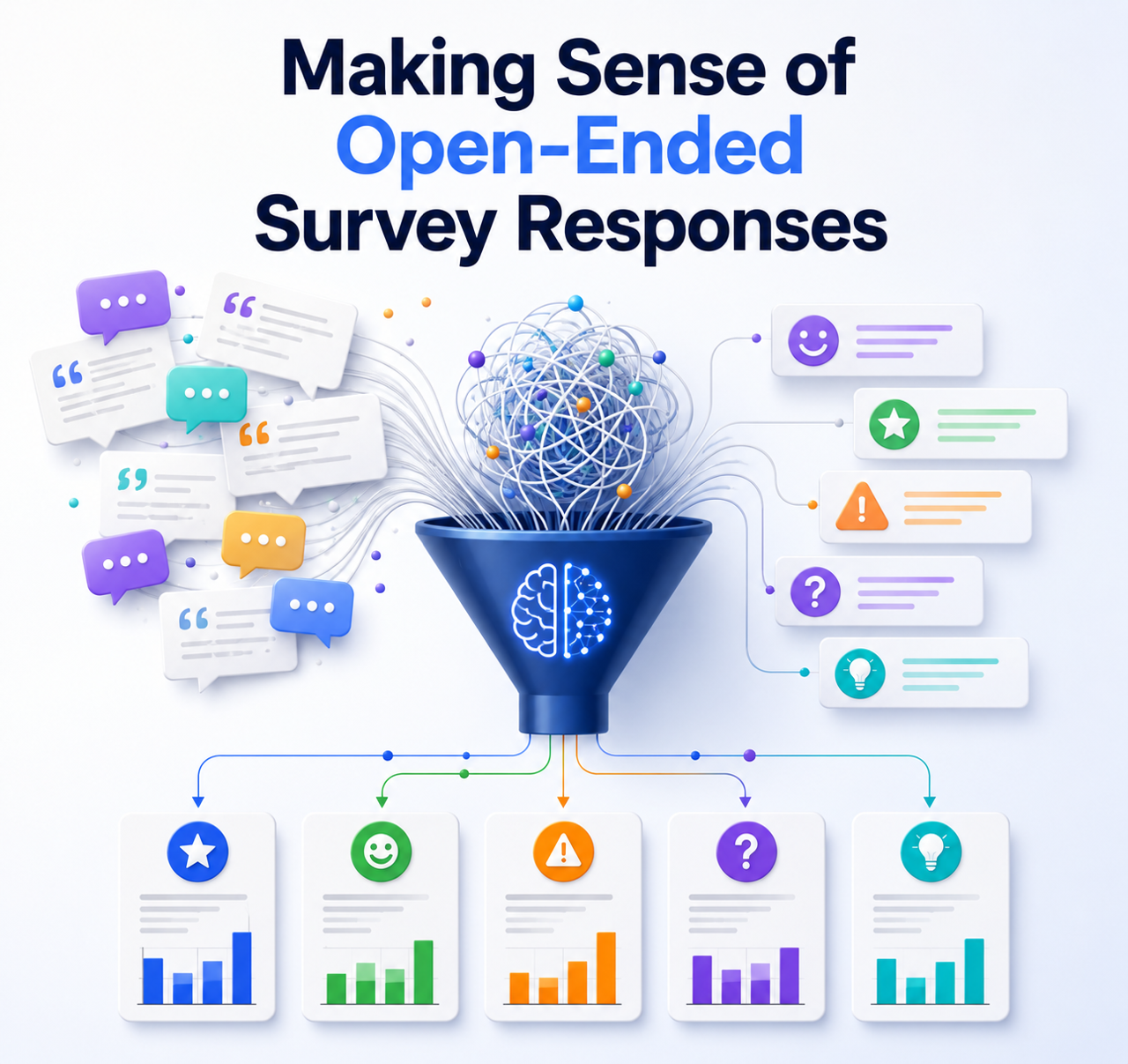
Surveys have always had a tension built into them. Closed questions, where respondents choose from a list of options, are easy to analyse but limit what you can learn. Open-ended questions, where respondents write in their own words, are richer but hard to process at scale.
AI resolves this tension. Natural language processing tools can read through thousands of open-ended customer feedback responses, group them by theme, and tell you what proportion of respondents mentioned each theme. This turns the qualitative richness of open-ended responses into quantifiable customer insights without losing the nuance.
This is particularly valuable for businesses running regular customer satisfaction surveys, where the volume of customer feedback makes manual coding impractical. It is also useful for voice of the customer programmes, where ongoing feedback is being collected across multiple touchpoints and needs to be synthesised into a coherent picture.
Listening to Unsolicited Customer Feedback to Build Richer Customer Insights
Some of the most honest customer feedback is the feedback customers were not specifically asked to provide. Reviews, social media posts, forum discussions, and community conversations are all forms of unsolicited expression that contain a great deal of useful customer insights.
AI allows businesses to monitor these channels continuously and systematically. Social listening tools powered by AI can track brand mentions, identify emerging conversations, flag negative spikes in sentiment analysis scores, and detect trending topics that might be relevant to the business.
This kind of monitoring goes beyond reputation management, though that is certainly part of it. It also provides an early warning system for product issues, a window into how customers are using products in ways the business may not have anticipated, and a source of inspiration for new features or improvements.
Using Customer Insights to Power Personalisation and Deeper Customer Understanding
AI is also reshaping how businesses use customer data to personalise experiences. This goes beyond recommendations and targeted advertising, though those are part of it. It extends into understanding the different types of customers a business serves and what each of them needs.
By analysing behavioural data alongside customer feedback data, AI can help businesses identify distinct customer segments that may not be obvious from traditional demographic analysis. A segment defined by how customers interact with a product, what they complain about, and what they recommend to others is often more useful than one defined simply by age or location.
This kind of segmentation, built on real customer insights, informs product development, customer service strategies, and communication approaches. It helps businesses move away from one-size-fits-all thinking toward something more tailored, without requiring the manual effort that personalisation has traditionally demanded.
Using AI in Customer Service Interactions to Improve Customer Feedback Loops
Beyond analysing customer feedback after the fact, AI is also being used to improve customer interactions in real time. This includes chatbots and virtual assistants that handle routine queries, but it also includes tools that support human agents during live interactions.
Agent assistance tools, for example, can analyse a conversation in real time and suggest relevant responses, flag escalation risks, or surface information from previous interactions that might help the agent resolve the issue more quickly. These tools do not replace human judgment; they give agents better information to work with.
Post-conversation sentiment analysis is another application. AI can review service transcripts to identify coaching opportunities, common resolution paths, and systemic issues that are driving contact volumes. This turns the service function from a cost centre into a rich source of customer insights and experience intelligence.
What Good Customer Insights and Customer Feedback Practice Looks Like
The businesses getting the most value from AI in customer insights tend to share a few common characteristics. They have invested in connecting their data sources so that customer feedback from different channels can be brought together rather than analysed in isolation. They treat AI as a tool for enabling better human judgment, not for replacing it. And they have clear questions they are trying to answer, rather than hoping the AI will tell them something interesting without any direction.
That last point is worth emphasising. AI is very good at finding patterns, but it works best when those patterns are being searched for with a specific purpose in mind. Organisations that approach AI-powered customer feedback work with well-framed research questions tend to get far more useful outputs than those that simply run data through a model and wait to see what comes out.
How Insights Curry Supports Customer Insights and Customer Feedback Work
At Insights Curry, we help businesses get serious about customer understanding. We combine AI-powered sentiment analysis with experienced research thinking to turn customer feedback, behavioural data, and customer conversations into clear, actionable customer insights.
Whether you are trying to understand why satisfaction scores are dropping, what drives loyalty among your best customers, or how perceptions of your brand are shifting, we can help you design the right approach and get to answers you can actually use.
We work with businesses across a range of sectors and are used to dealing with messy, high-volume data environments. If you are not getting the customer insights you need from the customer feedback you are already collecting, that is usually something we can fix.

Frequently Asked Questions
What types of customer feedback can AI analyse to generate customer insights?
AI can process many forms of customer feedback, including written text from surveys and reviews, transcripts from calls or chat sessions, social media posts, and behavioural data such as click paths or usage patterns. The most commonly used applications involve text analysis and sentiment analysis, where the volume of material makes manual review impractical.
Do I need a large amount of data for AI-driven customer insights and sentiment analysis to be useful?
More data generally means more reliable patterns, but useful analysis is possible with moderate volumes depending on the application. Sentiment analysis on a few hundred reviews, for example, can still surface meaningful themes. The key is having enough customer feedback to see patterns rather than just individual instances.
How do I protect customer privacy when using AI to analyse customer feedback?
This depends on how the AI system is set up and what data it has access to. Responsible AI use in customer insights involves anonymising data where possible, limiting access to personally identifiable information, and ensuring that the tools used comply with relevant data protection regulations. Any reputable research or analytics partner will have clear policies on this.
Can AI replace customer feedback surveys entirely?
Not entirely. Surveys let you ask specific questions and get customer feedback that is directly relevant to those questions. AI analysis of unsolicited feedback is valuable, but it can only surface what customers happen to mention. The two approaches work best in combination, with surveys providing structured data on specific topics and AI-powered sentiment analysis of open-ended content providing context and depth.
How long does it take to get customer insights from AI-powered customer feedback analysis?
This varies depending on the volume and format of the data, but AI analysis is substantially faster than manual approaches. A dataset of customer feedback that might take a team of analysts several weeks to process manually can often be analysed in hours or days with the right tools in place.