

Market research has changed more in the past five years than in the previous twenty. The shift has been driven partly by the volume of data now available, partly by the speed at which markets move, and partly by the arrival of artificial intelligence tools capable of processing both at a scale no human team could match.
At the centre of this shift is a category of software that is becoming increasingly central to how organisations understand their markets: the AI market research platform. If you have encountered this term and wondered what it actually means, what these platforms can do, and whether one might be relevant to your work, this piece is designed to answer those questions clearly and practically.
What is an AI Market Research Platform?
An AI market research platform is a software tool that uses artificial intelligence to support and accelerate market research activity. This includes everything from designing and fielding surveys to analysing large volumes of unstructured text, monitoring consumer sentiment across digital channels, and generating insight summaries from complex datasets.
The defining characteristic of an AI market research platform is that it uses machine learning, natural language processing, and related AI techniques to do work that would previously have required significant manual effort. Instead of a researcher spending days reading and coding open-ended survey responses, the platform processes them automatically and produces a structured summary of the themes that emerge.
An AI market research platform is not a single type of tool. The category includes social listening platforms, automated survey analysis tools, AI-powered qualitative research assistants, integrated insight management systems, and platforms that combine multiple research methodologies in one environment. What they share is the use of AI to make research faster, more scalable, and more accessible.
Core Features of an AI Market Research Platform
The features available in AI market research platforms vary depending on their focus, but several capabilities appear consistently across the more capable tools in the category.
Natural Language Processing for Text Analysis
Natural language processing is the foundation of most AI market research platforms. It allows the platform to read unstructured text, whether from survey responses, customer reviews, social media, or interview transcripts, and extract structured insights from it. This includes identifying themes, detecting sentiment, flagging emotional intensity, and categorising responses by topic.
The quality of NLP varies significantly between AI market research platforms, and it is one of the most important features to evaluate carefully. A platform with strong NLP can reliably interpret nuanced language, handle colloquialisms and industry jargon, and produce theme summaries that match what an experienced human analyst would identify. A platform with weak NLP produces outputs that require significant correction before they can be used.
Automated Survey Design and Analysis
Most AI market research platforms include tools for designing and fielding surveys. The AI layer adds capabilities that go beyond what standard survey software provides. Adaptive questioning logic adjusts the survey in real time based on how each respondent answers. Automated data quality controls identify and remove poor-quality responses. AI-generated analysis turns closed and open-ended responses into structured findings without manual coding.
For research teams that rely heavily on surveys, this combination of smarter data collection and automated analysis is one of the most immediately valuable features an AI market research platform can offer.
Sentiment Analysis and Consumer Monitoring
Sentiment analysis is the ability to determine whether a piece of text expresses a positive, negative, or neutral attitude toward a subject, and often to break that down by specific topic or theme. An AI market research platform with strong sentiment analysis capabilities can monitor consumer opinion across thousands of sources simultaneously, alerting teams when sentiment shifts and providing a continuous view of how brands, products, and categories are being perceived.
This feature is particularly valuable for brand management, product launch monitoring, and competitive intelligence. It transforms consumer monitoring from a periodic exercise into an ongoing capability that keeps teams informed as opinions evolve rather than after they have shifted.
Predictive Analytics and Pattern Recognition
More advanced AI market research platforms go beyond describing what the data shows to predicting what is likely to happen next. Predictive analytics models can identify early indicators of emerging trends, forecast how consumer preferences are likely to shift, and estimate the likely impact of product or marketing decisions before they are made.
Pattern recognition capabilities allow AI market research platforms to surface connections between variables that would not be visible in a manual analysis. Segments that behave differently, correlations between feedback themes and business outcomes, and anomalies that warrant investigation can all be identified automatically and surfaced to researchers for further exploration.
Automated Reporting and Insight Delivery
The final step in any research process is translating findings into a form that decision-makers can use. AI market research platforms increasingly include automated reporting capabilities that pull together key findings, generate visualisations, and produce narrative summaries from analytical outputs.
This does not eliminate the need for human judgment in reporting, but it does dramatically reduce the time spent on the mechanical aspects of putting findings together. Researchers who previously spent days building reports can instead spend that time refining the narrative and adding the contextual interpretation that makes findings genuinely useful.
Key Benefits of Using an AI Market Research Platform
The benefits of using an AI market research platform follow directly from its features, but it is worth making them explicit because they represent real changes in what research teams can accomplish.
Speed: From Weeks to Hours
The most immediate benefit of an AI market research platform is speed. Research that previously took weeks from data collection to insight delivery can now be completed in days or hours. This compression in the research cycle means findings reach decision-makers while they are still relevant, rather than arriving after the window of opportunity has already closed.
Scale: More Research From the Same Resources
An AI market research platform allows research teams to process far more data than they could handle manually. A team that previously had to sample from a large volume of feedback can now analyse all of it. A brand that previously monitored a handful of channels can now monitor everything relevant across its category. The same headcount produces a much broader and deeper view of the market.
Consistency: Reliable Analysis at Every Scale
Human analysis is subject to variation. Different analysts emphasise different things. Fatigue affects the consistency of manual coding over large datasets. An AI market research platform applies the same analytical approach to every data point, producing results that are more consistent and less subject to the biases that affect manual analysis at scale.
Accessibility: Research for More of the Organisation
By automating the most technically demanding parts of the research process, an AI market research platform makes research accessible to teams and individuals who would previously have needed specialist support to commission or conduct it. This democratisation of research means more decisions across the organisation can be informed by data rather than made on instinct.
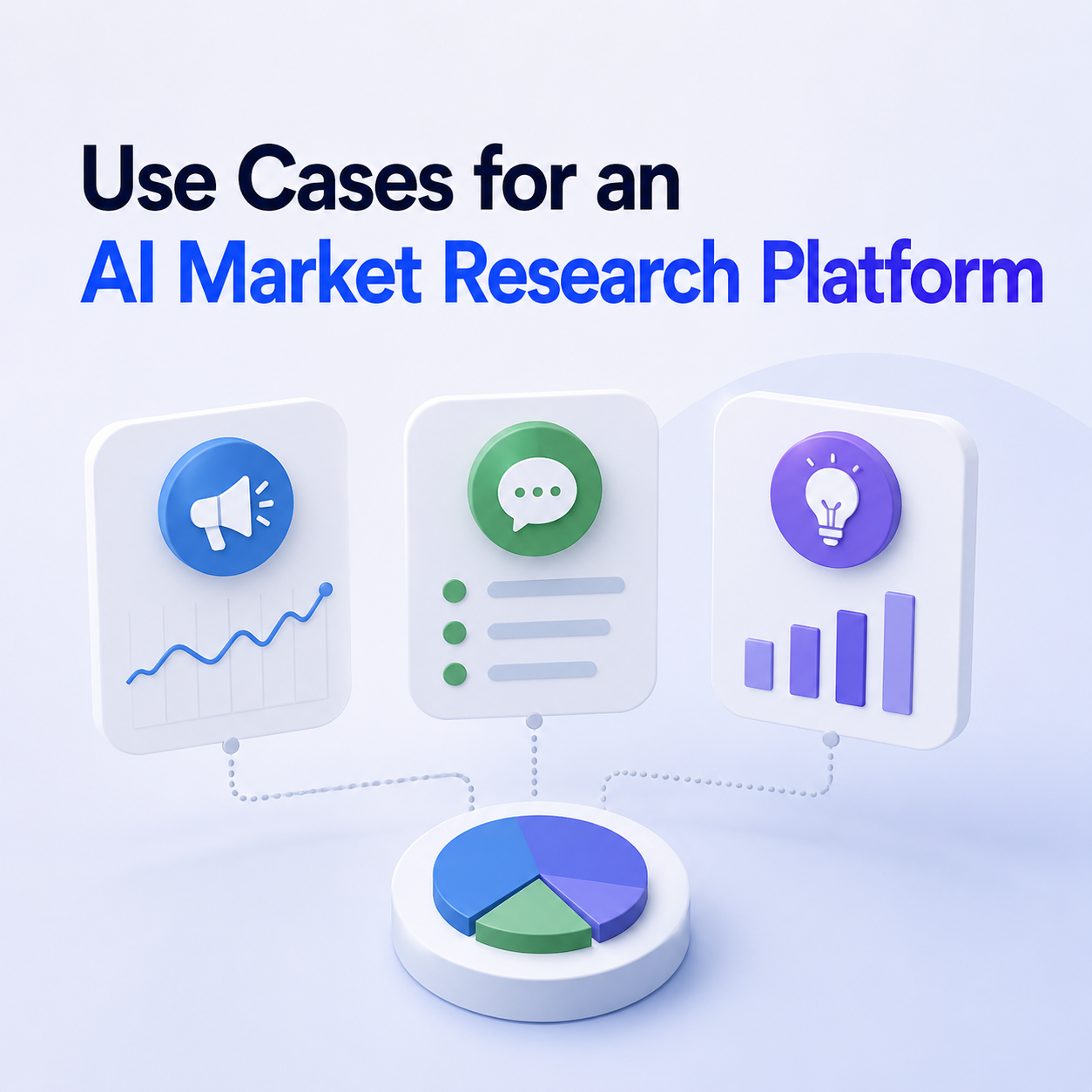
Use Cases for an AI Market Research Platform
Understanding where AI market research platforms deliver the most value in practice helps clarify whether and how they might be relevant to your work.
- Brand tracking and reputation monitoring: Continuous analysis of how a brand is perceived across consumer channels, with alerts when sentiment shifts or new themes emerge.
- Product feedback analysis: Automated processing of app reviews, support tickets, and in-product surveys to identify recurring issues and emerging requests.
- Concept testing and feature validation: Rapid fielding and analysis of concept tests to validate ideas before development resources are committed.
- Competitive intelligence: Monitoring competitor activity, customer opinion of competitors, and market positioning shifts in near real time.
- Customer segmentation: AI-driven identification of distinct customer groups based on behavioural and attitudinal data.
- Trend detection: Early identification of emerging consumer interests, concerns, or behaviours before they become mainstream.
In each of these use cases, the AI market research platform accelerates and deepens the research while freeing human researchers to focus on interpretation and strategic application.
How Insights Curry Works With AI Market Research Platforms
At Insights Curry, we help organisations get the most from AI market research platforms. We work with clients to identify which platforms best fit their research needs, integrate them into existing workflows, and design research programmes that fully leverage their capabilities.
We also bring our own analytical expertise to the work, combining AI-powered processing with experienced research thinking to produce insights that are both fast and genuinely useful. Our goal is always to help clients make better decisions, not just to produce more data.
If you are trying to understand what an AI market research platform could do for your organisation, or if you want help choosing or getting more from a platform you already have, we would be glad to talk.
Frequently Asked Questions
Is an AI market research platform the same as a survey tool?
Not exactly. Some AI market research platforms include survey functionality, but the category is broader. An AI market research platform typically combines survey analysis with social listening, sentiment analysis, automated reporting, and predictive analytics capabilities. A standard survey tool, even a sophisticated one, does not necessarily include the AI-powered analysis that distinguishes a dedicated AI market research platform.
How accurate is the analysis produced by an AI market research platform?
Accuracy varies by platform and by the specific capability being used. Natural language processing and sentiment analysis tools have improved significantly in recent years and can be highly accurate when applied to content in the languages and categories they have been trained on. The most reliable approach is to evaluate platform accuracy on data similar to your own rather than relying on vendor claims.
Do I need technical expertise to use an AI market research platform?
Most AI market research platforms are designed for use by research professionals rather than data scientists or engineers. Technical expertise can help you get more from advanced features, but the core functionality of a well-designed platform should be accessible to non-technical researchers. Ease of use varies significantly between platforms and is worth evaluating carefully.
How does an AI market research platform handle data privacy?
Data privacy requirements vary by platform and by the regulatory environment you operate in. Reputable AI market research platforms have clear policies on data storage, processing, and access, and are designed to support compliance with relevant regulations such as GDPR. Always review a platform's data privacy documentation carefully before committing to it.
What is the difference between an AI market research platform and a traditional research agency?
An AI market research platform is a software tool. A research agency is a team of people. The two are not direct substitutes. Platforms excel at processing large volumes of data quickly and consistently. Research agencies bring human judgment, strategic thinking, and methodological expertise that no platform currently replicates. Many organisations use both, with the platform handling scale and speed and the research partner providing the interpretation and strategy layer.