

Research has always been the foundation of good business decisions. But for most organisations, it has also been one of the most time-consuming parts of the process. Whether you are running a qualitative study to understand why customers behave a certain way, or a quantitative survey to measure how many of them feel a particular way, the work involved has traditionally been substantial.
AI is changing this in meaningful ways. It is making both qualitative and quantitative research faster, deeper, and more accessible. And it is doing this not by cutting corners, but by automating the parts of the process that do not require human creativity or judgment, freeing researchers to focus on what they do best.
This piece looks at how AI is reshaping both approaches, what that means in practice, and what organisations need to keep in mind as they adopt these tools.
Understanding the Difference Between Qualitative and Quantitative Research
Before exploring how AI fits in, it helps to be clear about what qualitative and quantitative research each involve and what they are designed to answer.
Quantitative research is about measurement. It uses structured methods such as surveys, polls, and behavioural tracking to generate numerical data that can be analysed statistically. It answers questions like how many, how often, and to what degree. The strength of quantitative research lies in its ability to produce findings that are statistically significant and generalisable across a larger population.
Qualitative research is about understanding. It uses methods such as depth interviews, focus groups, and ethnographic observation to explore the meanings, motivations, and experiences behind behaviour. It answers questions like why and how. The strength of qualitative research lies in its depth and its ability to surface insights that structured surveys simply cannot reach.
Both have important roles to play, and the most useful research programmes typically combine them. AI for qualitative and quantitative research is about making both approaches work better, not about replacing one with the other.
How AI Transforms Quantitative Research
Quantitative research has always been relatively well suited to automation because it involves structured data. But AI has extended what is possible significantly.
Survey Design and Adaptive Questioning
Traditional surveys ask every respondent the same set of questions in the same order. AI-powered survey platforms can now adapt in real time based on how a respondent answers, showing them more relevant follow-up questions and skipping sections that do not apply. This improves the quality of quantitative data collected while also reducing the burden on respondents.
AI can also help with survey design itself, identifying questions that are likely to produce unreliable responses due to leading language, double-barrelled framing, or ambiguity. This kind of intelligent design support can improve data quality before fieldwork even begins.
Faster Processing of Quantitative Data
Once quantitative data is collected, AI can clean it, weight it, and run initial analyses far more quickly than manual processes allow. It can flag outliers, identify data quality issues such as straight-lining or speeding, and produce summary outputs that give researchers a head start on interpretation.
For organisations running continuous tracking studies or large-scale surveys, this speed advantage is significant. What used to take days of data processing can now be done in hours, allowing findings to reach decision-makers faster.

Predictive Modelling in Quantitative Research
AI also opens up more sophisticated analytical possibilities within quantitative research. Predictive modelling, segmentation, and pattern recognition can now be applied to survey data in ways that surface insights beyond what descriptive statistics alone would reveal. This allows researchers to move from describing what is happening to understanding what is likely to happen next, which is often what decision-makers actually need.
How AI Transforms Qualitative Research
Qualitative research has traditionally been the area where AI had less to offer, given its reliance on human empathy, judgment, and interpretive skill. That is changing, and the change is more significant than many researchers expected.
AI for Qualitative Data Analysis at Scale
The most immediate impact of AI on qualitative research is in the analysis of qualitative data. Transcribing, coding, and analysing interviews and focus group sessions is enormously time-consuming work. A single depth interview might take several hours to transcribe and code manually. AI can now handle transcription automatically and with high accuracy, and it can apply thematic coding to transcripts at a fraction of the time it would take a human analyst.
This does not replace the interpretive judgment of a skilled qualitative researcher. But it does mean that the mechanical work of processing qualitative data can be handled much more efficiently, allowing researchers to focus on identifying what the themes mean and what they imply for the business.
Scaling Qualitative Research Without Losing Depth
One of the fundamental constraints of qualitative research has always been sample size. Because each interview or focus group session requires significant time and effort, qualitative samples have typically been small, usually between ten and thirty participants. This is usually sufficient for exploratory work, but it makes it harder to draw confident conclusions about broader populations.
AI is beginning to change this by enabling qualitative research at larger scales. AI-moderated interviews can conduct hundreds of conversational sessions simultaneously, gathering nuanced, open-ended responses from far more people than traditional qualitative methods allow. The depth of a single AI-moderated session is not identical to a skilled human moderator, but the ability to gather qualitative insights from a much larger and more representative sample is genuinely valuable.
Emotion and Sentiment Detection in Qualitative Research
AI tools can now detect emotional cues in language, identifying not just what people say but how they say it. In qualitative research, this adds a layer of analysis that would be difficult to apply consistently across large volumes of transcripts manually. Understanding where strong emotion appears in a conversation, and what topics trigger it, can significantly deepen the insight available from qualitative data.
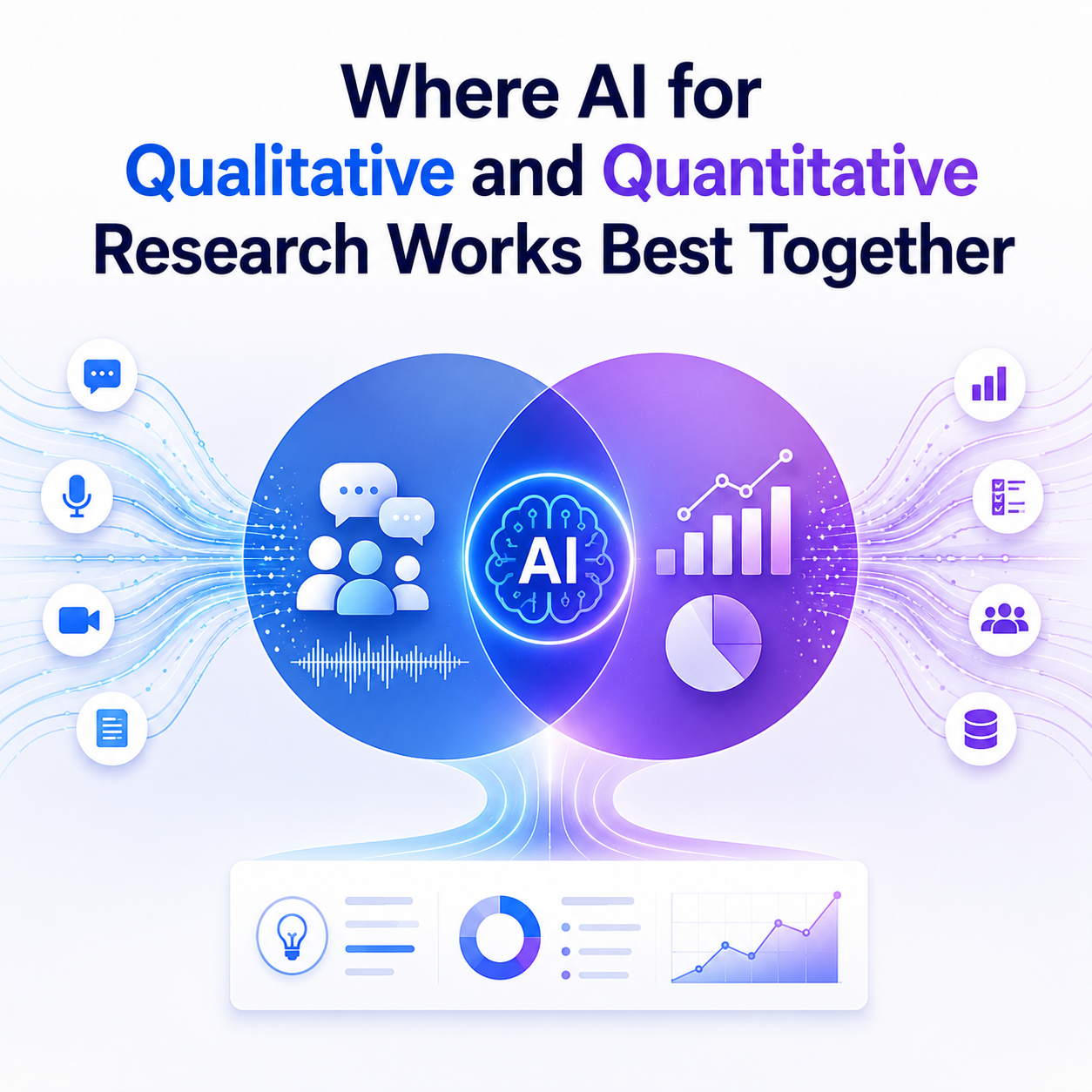
Where AI for Qualitative and Quantitative Research Works Best Together
The greatest value often comes from combining AI-enhanced qualitative and quantitative research in a single programme. Quantitative research identifies patterns across a large sample. Qualitative research explains why those patterns exist. When both are enhanced by AI, the result is a research programme that is both broader in reach and deeper in understanding than traditional approaches would allow.
For example, a large-scale quantitative survey might reveal that satisfaction scores have dropped among a specific customer segment. AI-moderated qualitative interviews with members of that segment can then explore what is driving the decline in a way that the survey data alone cannot. The combination produces both statistical evidence of a problem and a nuanced understanding of its root causes.
What Organisations Need to Keep in Mind
AI for qualitative and quantitative research is powerful, but it works best when applied thoughtfully. A few considerations are worth keeping in mind.
Research questions still need to be well-designed. AI amplifies the quality of your inputs. Vague or poorly framed research questions will produce outputs that are faster to generate but no more useful than they would have been under traditional methods.
Human interpretation remains essential. AI can identify patterns and themes, but it cannot replace the contextual knowledge and strategic judgment that experienced researchers bring to the interpretation of findings. The best results come from treating AI as a capable assistant rather than a substitute for research expertise.
Data quality matters. For quantitative research, this means ensuring that samples are representative and that data collection methods are rigorous. For qualitative research, it means ensuring that the questions asked are genuinely open and that respondents feel comfortable sharing honest responses.
How Insights Curry Uses AI for Qualitative and Quantitative Research
At Insights Curry, we use AI-powered tools across both qualitative and quantitative research to deliver faster, richer, and more actionable findings for our clients. We believe that the best research combines the efficiency of AI with the depth of experienced human thinking.
Whether you are designing a large-scale quantitative tracking study, exploring a new market through qualitative interviews, or looking to combine both approaches in a connected programme, we can help you design and deliver research that actually moves your business forward.
Our team understands both the technical capabilities of AI research tools and the research craft that makes findings genuinely useful. We bridge that gap so that our clients get outputs they can act on, not just reports they file away.
Frequently Asked Questions
Can AI fully automate qualitative research?
Not fully, and it is unlikely to in the near term. AI can automate significant parts of qualitative research, including transcription, thematic coding, and initial analysis. But the interpretive judgment that makes qualitative research genuinely insightful still requires experienced human researchers. AI works best as a tool that supports qualitative researchers, not as a replacement for them.
Is AI-generated quantitative analysis reliable?
When applied correctly, yes. AI-powered quantitative analysis can be extremely reliable, often more consistent than manual analysis because it does not suffer from fatigue or human error in repetitive tasks. The key is ensuring that the data going in is of good quality and that the analytical approach is appropriate for the research question being addressed.
What types of qualitative data can AI analyse?
AI can work with text transcripts from interviews and focus groups, written responses to open-ended survey questions, social media and online review content, and increasingly with video and audio data for emotion detection. The range of qualitative data types that AI can process continues to expand as the technology develops.
How do I decide whether I need qualitative or quantitative research?
This depends on the question you are trying to answer. If you need to measure something, understand the scale of a phenomenon, or test a hypothesis across a large population, quantitative research is the right starting point. If you need to understand why something is happening, explore an unfamiliar topic, or develop hypotheses to test, qualitative research is the more appropriate choice. Many of the most useful research programmes use both.
How much does AI change the cost of market research?
AI can significantly reduce the cost of certain parts of the research process, particularly data processing and analysis. However, the design and interpretation of research still require skilled human input, and those elements remain a core part of the investment. The overall effect is that more research can be done for the same budget, or that the same scope of research can be delivered faster.