

Introduction
Every successful market research project begins with one critical element: asking the right questions.
Whether an organization wants to understand customer satisfaction, evaluate a new product idea, measure brand perception, or study changing consumer behavior, the quality of the questionnaire directly affects the quality of the insights. Even the most advanced analytics cannot compensate for poorly designed questions, unclear wording, or a survey structure that confuses respondents.
Yet questionnaire design remains one of the most time-consuming parts of market research. Researchers spend hours refining question flow, checking for bias, selecting response scales, and making sure every question connects to the research objective. For organizations managing several studies at once, that manual process can quickly become a bottleneck.
This is where an AI questionnaire generator can make a practical difference.
Instead of replacing researchers, AI helps them handle repetitive parts of questionnaire development more efficiently. It can suggest questions, improve wording, identify potential issues, and help create a logical survey structure. Researchers can then spend more time reviewing the research strategy and interpreting the findings.
InsignAI takes this approach further with an AI-native market research platform built around research methodology rather than generic content generation. Its AI questionnaire generator is designed to help research teams create structured questionnaires aligned with research objectives while reducing the time spent on manual drafting and revisions.
In this article, we explore how InsignAI's AI questionnaire generator accelerates market research, reduces repetitive work, and helps organizations create more consistent and effective questionnaires.
Why Questionnaire Design Matters More Than Most Businesses Realize
Questionnaires are often treated as simple lists of questions.
They are much more important than that.
A questionnaire determines what information researchers collect and, ultimately, what decisions can be made from the research. Poorly designed questions can introduce bias, confuse respondents, reduce completion rates, and produce data that is difficult to interpret.
Experienced researchers typically consider several factors before finalizing a question:
- Is the wording clear and neutral?
- Does the question support the research objective?
- Is the response format appropriate?
- Does the question appear in the right place?
- Could an earlier question influence the respondent's answer?
- Is the overall survey too long?
Getting all of these elements right takes time, particularly when several stakeholders are involved in reviewing and revising the questionnaire.
As organizations conduct research more frequently, starting every questionnaire from a blank page becomes increasingly difficult to manage.
The Traditional Challenges of Questionnaire Development
Most research teams have a structured approach to questionnaire design. The problem is that much of the process involves repetitive work.
Time-consuming drafting
Researchers often begin with a research brief and manually turn objectives into individual survey questions.
The first version is rarely the final version. Questions are rewritten, removed, reordered, and reviewed several times before the questionnaire is ready.
For complex studies, this can take days.
Maintaining consistency
Large organizations may have several researchers working across different projects and departments.
Without a common approach, question wording, response scales, and survey structures can vary considerably from one study to another. This can make it harder to maintain consistency across research programs.
An AI questionnaire generator can provide a standardized starting point while still allowing researchers to make project-specific decisions.
Identifying potential bias
Leading questions, double-barreled questions, unclear wording, and assumptions about respondents can all affect research quality.
Experienced researchers know what to look for, but reviewing every question manually takes time.
AI can assist by flagging potential problems during the early stages of questionnaire development.
Balancing survey length
A questionnaire needs to collect enough information without exhausting respondents.
Long surveys can lead to fatigue, incomplete responses, and lower-quality answers. Researchers therefore have to make difficult decisions about which questions are genuinely necessary.
An AI-assisted approach can help teams build a focused first draft before human researchers refine the final questionnaire.
How AI Is Transforming Questionnaire Design
Artificial intelligence is changing how organizations approach the early stages of market research.
Instead of creating every questionnaire entirely from scratch, researchers can use an AI questionnaire generator to produce an initial structure based on the objectives of the study.
AI can assist with tasks such as:
- Generating initial survey questions
- Improving question wording
- Identifying potentially ambiguous questions
- Suggesting logical question sequences
- Recommending suitable response formats
- Reducing repetitive editing
The important distinction is that AI does not have to make the final research decisions.
Researchers remain responsible for deciding what should be measured, who should be surveyed, and how the findings will be interpreted. AI simply reduces the amount of routine work required to get from a research objective to a workable questionnaire.
This makes the process faster without removing the human judgment that good research requires.
How InsignAI's AI Questionnaire Generator Works
InsignAI approaches questionnaire generation with a market research focus rather than treating it as a general writing task.
Its dedicated Market Research LLM is designed around research methodologies, questionnaire logic, respondent behavior, and business objectives. This allows the InsignAI AI questionnaire generator to create questionnaires based on the purpose of the research rather than simply producing a collection of generic questions.
The process begins with a clearly defined research objective.
For example, a business may want to understand:
- Customer satisfaction
- Brand awareness
- Product usage
- Purchase intent
- Employee engagement
- New product feedback
The AI can use these objectives to generate an initial questionnaire structure.
Researchers can then review the questions, make changes, remove unnecessary items, and add questions that are specific to the study.
This creates a practical balance between automation and research expertise. Instead of spending hours creating the first draft, researchers start with a structured foundation they can improve.
Generating Better Questions Faster
One of the most useful advantages of an AI questionnaire generator is the ability to speed up the initial drafting process.
Rather than spending hours brainstorming questions, research teams can quickly create a structured starting point and dedicate more time to reviewing whether the questionnaire actually answers the business problem.
An AI-assisted questionnaire can support several important areas.
Clear question wording
Questions should be easy for respondents to understand without requiring unnecessary interpretation.
AI can help simplify complicated wording and identify questions that may create confusion.
Logical survey flow
The order of questions matters.
A well-structured questionnaire moves respondents naturally from one topic to another rather than jumping between unrelated subjects.
InsignAI's approach helps researchers create a logical structure that can then be reviewed and customized before deployment.
Appropriate response formats
Different research questions require different ways of collecting answers.
Depending on the objective, an AI questionnaire generator can help researchers consider formats such as:
- Multiple choice
- Rating scales
- Ranking questions
- Open-ended questions
- Matrix questions
Choosing the right format makes the questionnaire easier to answer and the resulting data easier to analyze.
Reducing potential bias
AI can also help identify wording that may unintentionally lead respondents toward a particular answer.
Researchers still need to review these suggestions, but having potential issues highlighted earlier can make the review process more efficient.
Built for Research, Not Just Content Generation
Many general-purpose AI tools can generate survey questions when given a suitable prompt.
But creating a useful market research questionnaire requires more than generating grammatically correct sentences.
Researchers need to consider methodology, respondent behavior, research objectives, data quality, and the decisions that the study is intended to support.
This is where InsignAI's approach is different.
The platform is designed specifically around market research workflows. Its AI capabilities connect questionnaire design with survey programming, sampling, data quality management, AI-driven text analytics, dashboards, and reporting.
That means the InsignAI AI questionnaire generator is not simply a standalone tool for producing questions. It forms part of a broader research workflow designed to help organizations move from research planning to usable insights more efficiently.
Accelerating the Entire Research Workflow
Creating the questionnaire is only one stage of a research project.
Once the questions are finalized, researchers still need to program the survey, test it, launch it, monitor responses, validate the data, analyze results, and prepare reports.
When these activities are managed through separate tools, researchers often spend unnecessary time transferring information between systems.
InsignAI brings these stages together within an AI-native research platform.
The questionnaire can become the starting point for a broader workflow that includes survey execution, sampling, data quality, AI-powered analytics, dashboards, and reporting.
For organizations running multiple studies, this connected approach can reduce manual handoffs and create a more consistent process from research design through final reporting.
Business Benefits of InsignAI's AI Questionnaire Generator
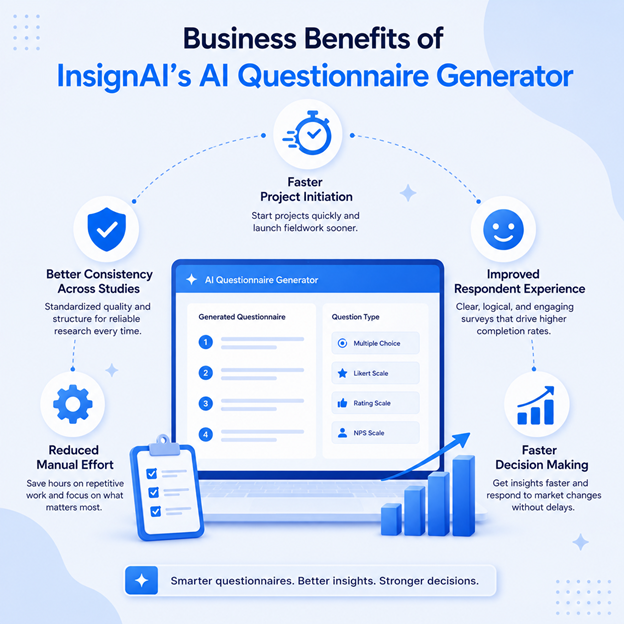
Organizations are under pressure to conduct research faster while maintaining quality. An AI-assisted questionnaire workflow can help address both requirements.
Faster project initiation
Researchers can begin with an AI-generated questionnaire rather than spending days developing the first draft manually.
This can shorten the time between defining the research objective and launching the study.
Greater consistency
An AI-assisted process provides researchers with a standardized starting point.
This can be particularly useful for large organizations where multiple teams conduct research across different markets or departments.
Better use of researcher time
Researchers spend less time on repetitive drafting and editing and more time on tasks that require human judgment.
They can focus on research design, validation, interpretation, and recommendations.
Improved respondent experience
Clear wording, logical sequencing, and appropriate response formats can make surveys easier to complete.
A better questionnaire experience can contribute to more useful responses and reduce unnecessary respondent frustration.
Faster access to insights
When questionnaire development takes less time, the overall research timeline can also become shorter.
For businesses operating in rapidly changing markets, getting reliable customer feedback sooner can make a meaningful difference.
Supporting Researchers Rather Than Replacing Them
There is a tendency to assume that AI will remove the need for researchers.
That is not how effective AI-assisted research should work.
A good AI questionnaire generator can handle repetitive tasks, but experienced researchers still need to define the research problem, assess the quality of questions, understand the target audience, and decide how findings should influence business decisions.
Think of the technology as a research assistant.
It can help:
- Create the first draft
- Improve question clarity
- Identify potential issues
- Suggest alternative wording
- Maintain a consistent structure
The researcher remains responsible for the final questionnaire
This combination allows organizations to gain the efficiency of automation without giving up the judgment and experience required for high-quality market research.
Real World Applications Across Industries
An AI questionnaire generator can support research across many industries because organizations in almost every sector need customer and stakeholder feedback.
Consumer Goods
Brands can create questionnaires for customer satisfaction studies, product concept testing, packaging research, and purchase behavior.
Retail
Retailers can research shopping experiences, loyalty programs, pricing strategies, promotions, and customer expectations.
Technology
Technology companies can use surveys to understand user satisfaction, evaluate new features, identify usability challenges, and collect product feedback.
Healthcare
Healthcare organizations can conduct patient experience research and evaluate service quality through structured feedback programs.
Financial Services
Banks and financial institutions can use questionnaires for customer satisfaction studies, digital banking research, brand perception, and service evaluations.
The research objectives may differ, but the underlying requirement remains the same: organizations need clear questions that generate useful answers.
Why an AI Native Research Platform Matters
Using AI to generate a questionnaire is useful. Using it as part of a complete research system can be even more valuable.
Market research involves much more than writing questions. It includes sampling, data quality, survey execution, analysis, visualization, and reporting.
InsignAI brings these capabilities together within one research ecosystem.
Its dedicated Market Research LLM is designed specifically for research applications, while the broader platform connects questionnaire design with the later stages of research.
This unified approach can help organizations:
- Standardize research workflows
- Reduce dependence on disconnected tools
- Improve collaboration between teams
- Reduce repetitive manual work
- Deliver research findings faster
For enterprises conducting research at scale, the value comes not only from generating questions faster but from improving the efficiency of the entire research operation.
Best Practices for AI Assisted Questionnaire Design
AI works best when researchers use it thoughtfully.
A few practical guidelines can improve the results:
- Start with a clearly defined research objective.
- Give the AI enough context about the study and target audience.
- Review every AI-generated question before launch.
- Remove questions that do not directly support the research objective.
- Check wording for bias and ambiguity.
- Keep the questionnaire focused and reasonably short.
- Use both closed-ended and open-ended questions when appropriate.
- Test the questionnaire with a small group before full deployment.
- Use researcher expertise to make the final decisions.
The goal is not to automate questionnaire design completely. The goal is to make the process faster while preserving research quality.
Conclusion
Questionnaire design has always been one of the most important parts of market research, but it does not have to remain one of the slowest.
An AI questionnaire generator can help research teams move from a blank page to a structured questionnaire much faster. By assisting with question creation, wording, structure, and potential quality issues, AI reduces repetitive work and gives researchers more time to focus on the parts of research that require human judgment.
InsignAI's AI questionnaire generator takes this a step further by placing questionnaire generation within a broader AI-native market research platform. With capabilities spanning questionnaire design, survey programming, sampling, data quality, analytics, dashboards, and reporting, InsignAI helps organizations connect the different stages of research instead of managing them as separate tasks.
The result is a more efficient research workflow, better consistency, and faster access to insights.
As businesses need customer intelligence more frequently, the ability to design and execute high-quality research quickly will become increasingly important. AI will not replace experienced researchers. Instead, the strongest research teams will use AI to remove repetitive work while keeping human expertise at the center of decision making.
Build Better Questionnaires in Less Time
Great research starts with asking the right questions.
Want to see how InsignAI's AI questionnaire generator can help your research team create better questionnaires, reduce manual effort, and accelerate the journey from research objectives to actionable insights?
Frequently Asked Questions
1. What is an AI questionnaire generator?
An AI questionnaire generator uses artificial intelligence to create structured survey questions based on a defined research objective. It can help researchers draft questions, improve wording, organize survey flow, and consider appropriate response formats.
2. How does InsignAI's AI questionnaire generator work?
InsignAI uses a dedicated Market Research LLM designed for research workflows. It uses research objectives and context to help create structured questionnaires that researchers can review, refine, and customize before deployment.
3. Can an AI questionnaire generator replace market researchers?
No. AI can automate repetitive parts of questionnaire development, but researchers still need to define objectives, validate questions, assess methodology, and interpret the resulting research.
4. Which industries can use an AI questionnaire generator?
Consumer goods, retail, technology, healthcare, financial services, and many other industries can use AI-assisted questionnaire design for customer research, product research, satisfaction studies, brand research, and other market research projects.
5. What makes InsignAI different from general AI writing tools?
InsignAI is built specifically for market research rather than general content generation. Its AI questionnaire generator forms part of a broader research platform that connects questionnaire design with survey programming, sampling, data quality, AI-powered analytics, dashboards, and reporting.