

Best Practices for Creating Surveys with an AI Questionnaire Generator
Most survey problems don't start in the data. They start in the design.
A question that seemed clear to the person who wrote it confuses half the respondents who answer it. A scale format that works for satisfaction doesn't work for frequency. A logic path that tested fine internally sends an entire segment of respondents somewhere they shouldn't be. By the time any of this becomes visible, the survey is closed and the data is already compromised.
AI questionnaire generators are changing how fast you can build a survey. The teams getting the most out of them are the ones that understand that speed isn't the only thing on the table. A poorly designed survey produced in ten minutes is still a poorly designed survey. Good AI survey design is not simply about generating questions quickly. It is about using AI to support the principles that make those questions useful in the first place.
These are the practices that separate surveys built with AI that produce reliable data from ones that just get built quickly.
Start with a Decision, Not a Topic
The most common briefing mistake when using an AI questionnaire generator is telling it what the survey is about rather than what decision the survey needs to support.
"A survey about customer satisfaction" and "a survey to understand whether satisfaction has dropped because of our new pricing tier, and if so which customer segments are most affected" will produce completely different instruments. The first is a topic. The second is a research question with a decision attached to it.
AI questionnaire generators work better the more specific the brief. Before you type anything into the tool, write down: what decision gets made differently depending on what this survey finds? That answer is the brief. Feed that into the generator, not just the subject area.
This matters because a well-specified brief produces a questionnaire structure that actually earns its findings. A vague brief produces a questionnaire that covers the topic without connecting to the decision, which is how you end up with a lot of data and no clarity. Strong AI survey design starts with this connection between the research objective and the decision the findings need to support.
Review Generated Questions for the Problems AI Flags but Humans Miss
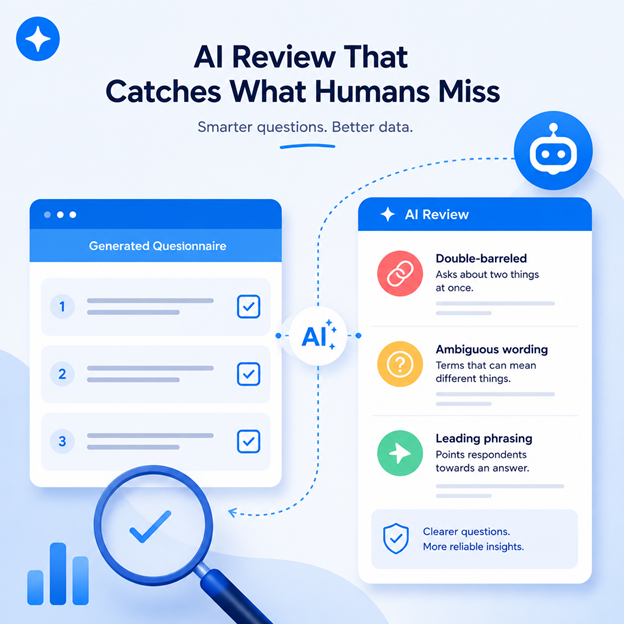
One of the genuine advantages of AI questionnaire generators is that they can also review their own output, and more importantly, catch design problems that human reviewers routinely miss because familiarity blinds them.
Run the generated questionnaire back through the tool and ask it to flag:
Double-barreled questions. These ask about two things at once while leaving room for only one answer. "How satisfied are you with the price and quality?" forces respondents to average two different evaluations into a single response. The resulting data can't tell you which part of the experience drove the score. AI catches these reliably. Human reviewers who helped write the question often don't.
Ambiguous wording. Words that seem specific to the research team often aren't specific to respondents. "Premium," "regularly," "good value": each of these means something different depending on who's reading. AI trained on research methodology flags terms with high interpretive variance and suggests alternatives with more stable meaning across respondent groups.
Leading phrasing. Questions that point toward a preferred answer are easy to write accidentally, especially when the research team already has a hypothesis. "How useful did you find the new feature?" is leading. "How would you describe your experience with the new feature?" is not. The difference is subtle and AI catches it more reliably than a reviewer who is already invested in the question.
Don't skip this review step because the AI generated the questions in the first place. The generator and the reviewer can be the same tool without being the same function. This is an important part of effective AI survey design because generation and quality review serve different purposes.
Match Your Scale Format to Your Construct
This is the most common technical error in survey design and one of the least discussed. AI questionnaire generators can suggest appropriate scale formats, but they need to know what you're measuring to do it well.
Frequency constructs work on frequency scales: never, rarely, sometimes, often, always. Putting them on an agreement scale produces data that can't be interpreted meaningfully.
Satisfaction constructs work on satisfaction scales, typically five or seven points. Stretching to ten points introduces false precision without adding analytical value for most research objectives.
Bipolar constructs, where the two ends represent genuinely opposite states, work best on odd-point scales with a true neutral midpoint. Unipolar constructs, where one end is simply absence of the other, don't need that midpoint.
When using an AI questionnaire generator, specify the construct type when you're briefing each section, not just the topic. "Questions about how frequently customers use each feature" tells the tool to build frequency scales. "Questions about how satisfied customers are with each feature" tells it to build satisfaction scales. The distinction matters more than most survey builders realize until the data comes back looking flat
Good AI survey design therefore depends on giving the generator enough methodological context to understand what each question is actually measuring.
Build the Question Order Around the Respondent, Not the Analyst
The order questions appear in a survey affects the answers those questions produce. This is one of the most well-documented effects in survey methodology and one of the most consistently underaddressed in practice.
The general principle: move from broad to specific, from easy to cognitively demanding, and from behavioral to attitudinal. Ask what customers do before you ask how they feel about it. Ask about overall satisfaction before asking about specific attributes. Ask about recent experience before asking about historical comparisons.
AI questionnaire generators can sequence questions to reduce order effects, but this requires telling them about the research objectives across the full questionnaire, not just one section at a time. If you build a survey section by section and then assemble them without reviewing the full sequence, you lose the ordering logic.
Ask the tool to review the complete question sequence before finalizing, specifically for priming effects: places where an earlier question is likely to make a later question's answer predictable rather than genuine.
This full-sequence review is an important part of AI survey design because individual questions can look perfectly reasonable while creating problems when viewed in the context of the complete questionnaire.
Keep It Shorter Than You Think It Needs to Be
There is almost no survey that wouldn't benefit from removing questions.
Research teams consistently overestimate how many questions respondents will answer carefully. Attention starts degrading around the fifteen-minute mark for most populations. Straight-lining, the behavior where respondents click the same answer repeatedly without reading, increases sharply in the back half of long surveys. Open-ended response quality drops: answers get shorter, vaguer, and less specific.
AI questionnaire generators make it easy to add questions because generating them takes seconds. That ease is a design risk. Just because the tool can add eight more questions doesn't mean those questions should be in the survey.
Straight-lining, the behavior where respondents click the same answer repeatedly without reading, increases sharply in the back half of long surveys.
A practical discipline: for every question in the draft, ask "what decision changes based on this answer?" If the honest answer is nothing, the question doesn't belong in the survey. AI generators can apply this filter if you ask them to, reviewing the full draft and flagging questions that don't connect to the stated research objectives.
Target ten to fifteen minutes maximum for a general population sample. Less for a specialist audience who will fatigue faster. Less again if you're running on mobile, where respondent patience is shorter and screen fatigue sets in earlier.
The ability to generate questions quickly should never become a reason to make surveys longer. Effective AI survey design uses AI to improve the questionnaire, not simply expand it.
Write the Analysis Plan Before the Questionnaire Is Final
This sounds counterintuitive but it's one of the most useful practices in survey design, with or without AI.
Before the survey goes live, write out the key findings you expect to report. Not the findings themselves, those are unknown, but the structure of the findings: "We will report satisfaction by customer segment," "We will compare feature usage frequency between new and established customers," "We will analyze the relationship between onboarding experience and 90-day retention."
Then check whether the questionnaire, as currently designed, can actually produce those analyses. Do you have a question that segments customers appropriately? Do you have frequency questions for each feature? Do you have an onboarding experience question that produces enough variation to correlate against retention data?
AI questionnaire generators can run this check for you if you give them the analysis plan alongside the questionnaire draft. They'll identify the gaps: findings you want to report that the current questionnaire can't support. Catching those gaps before fieldwork is free. Catching them after is expensive.
This is where AI survey design becomes more than question generation. The questionnaire needs to be designed with the eventual analysis in mind so that the data collected can support the decisions the research is intended to inform.
Test the Logic Paths Before You Launch
Skip logic, branching, and routing errors are survey killers. A respondent who gets sent to the wrong section, or who gets skipped past a question they should have answered, produces partial data that creates gaps in the analysis later.
AI questionnaire generators can validate routing logic across every possible answer path through the survey, which is something human reviewers almost never do completely. A survey with five branching points has enough unique paths through it that manual testing covers the main ones and misses the edges. AI tests all of them.
Make this validation a non-negotiable step before any survey goes live. Run the complete questionnaire through the tool with a specific request to trace every respondent path and identify any routing that sends someone somewhere unintended, skips a required question, or creates a dead end.
Catching a routing error in testing takes minutes. Catching it in the data, when you notice an unexpected gap in responses halfway through fieldwork, costs you sample, time, and sometimes the entire study.
For teams using an AI questionnaire generator, logic validation should be treated as part of the survey design process rather than an optional final check. It is one of the areas where AI can help researchers test complex survey structures more systematically.
Frequently Asked Questions
Can an AI questionnaire generator replace a research methodologist?
No, and the teams getting the most value from these tools aren't trying to make that trade. AI generators handle the parts of questionnaire design that are systematic and rule-based: spotting double-barreled questions, matching scale formats, validating routing logic, flagging leading phrasing. They don't handle the parts that require judgment about the business context, the strategic framing of findings, or the interpretation of unexpected results. The right framing is that AI handles the systematic checks so the methodologist's time goes toward the decisions that actually require expertise.
How specific does the brief need to be for an AI questionnaire generator to produce useful output?
Specific enough to name the decision the research supports. A topic is not a brief. A research question connected to a business decision is a brief. The more clearly you define what changes based on what the survey finds, the more the generator can structure the instrument to produce data that answers that specific question rather than just covering the subject area..
What's the most common mistake teams make when using AI to build surveys?
Treating generation as the final step rather than the first one. AI produces a usable draft faster than any human researcher can. That draft still needs a review pass for design problems, a sequence review for order effects, a logic validation for routing, and a length check against realistic respondent attention spans. Skipping those steps because the AI generated the questions doesn't make the questions immune to design problems.
InsignAI is a full-stack, AI-native market research platform with a dedicated Market Research LLM, built to design surveys that produce data worth acting on.