

The way we work is changing faster than most organisations can plan for. Email replaced memos. Cloud replaced servers. Remote work replaced the daily commute for millions. Each shift looked dramatic in the moment and obvious in hindsight. The arrival of AI inside everyday business workflows is the next shift, and it is unfolding in real time.
For business leaders, the more useful frame is not whether AI will change work but how the trends are already showing up and what to do about them. This blog walks through the trends shaping AI and the future of work, what they mean for how organisations operate, and where the smartest companies are placing their bets.
Trend 1: AI Is Moving from Pilot to Production — Reshaping the Future of Work
Two years ago, most enterprise AI conversations were about proofs of concept. Today the conversation has shifted to embedded use. AI is moving out of innovation labs and into the core of sales pipelines, customer service queues, marketing engines, finance close cycles, and HR workflows.
This matters because the value of AI is no longer about flashy demos. It is about quietly compressing time, reducing errors, and shifting human effort to higher value work. Companies that have crossed this threshold report meaningful gains in throughput, customer response time, and decision quality. Those still pilot heavy are at risk of falling behind not by years but by quarters.
Trend 2: The Rise of the AI Augmented Employee in the Future of Work
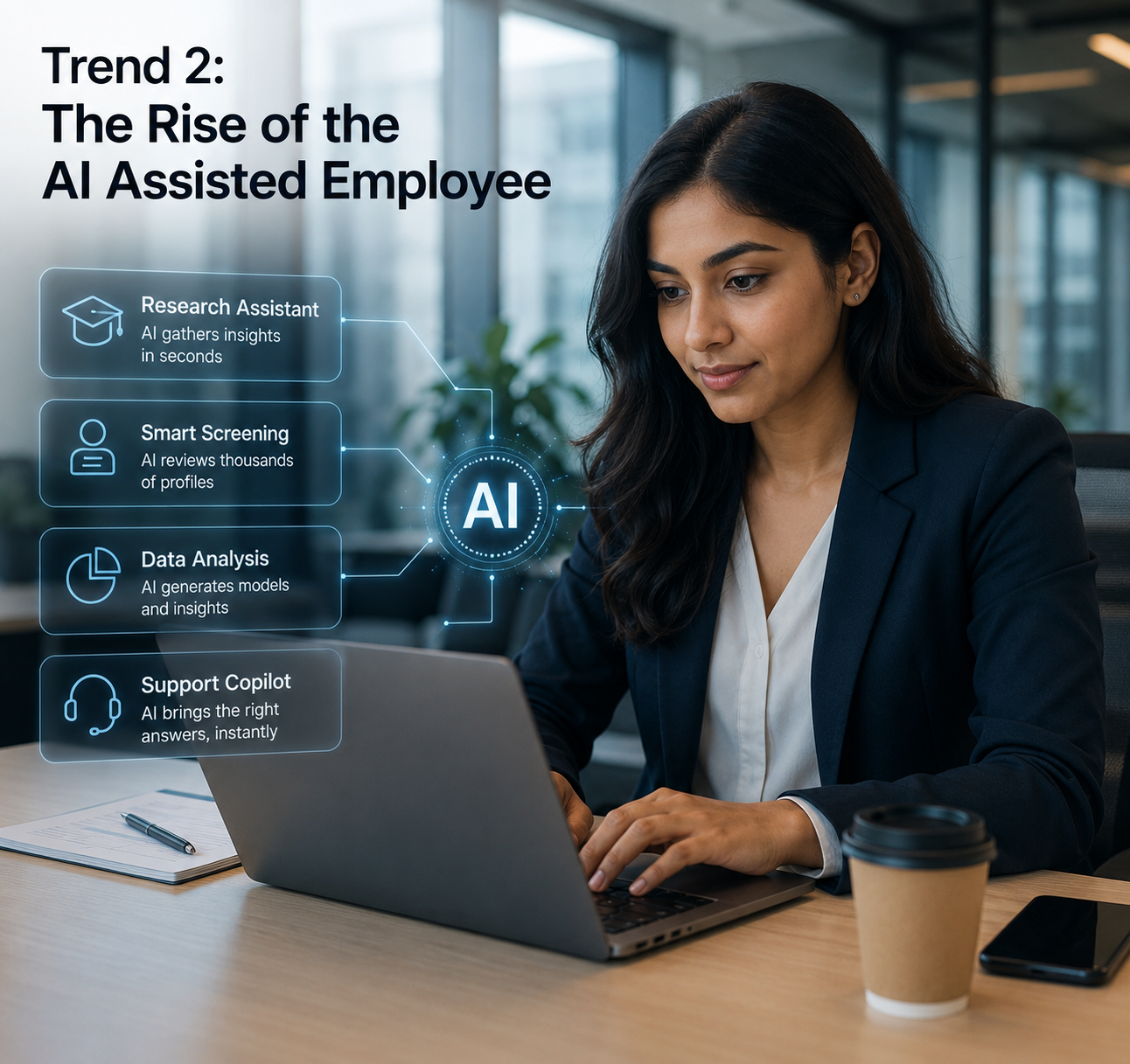
The most important workplace trend right now is not autonomous AI doing work on its own. It is AI augmented humans doing more in less time. A salesperson with a research assistant. A recruiter with a screener that reads thousands of profiles. A finance analyst with a draft model in seconds. A support agent with the entire knowledge base summarised on every call.
In this model, the employee remains in charge. AI handles the heavy lifting underneath. The output is better, faster, and more consistent than what either humans or AI could produce alone. Organisations that train their teams to work this way are seeing productivity gains that traditional automation never delivered.
Trend 3: How AI and the Future of Work Are Redesigning Workflows, Not Just Speeding Them Up
In the first wave, AI was bolted onto existing processes. A chatbot here, a summariser there. The next wave is structural. Companies are rebuilding workflows around what AI can now do natively. Onboarding flows that used to take a week happen in a day. Marketing campaigns that needed three teams are run by one with AI tooling. Financial closes are getting tighter as anomaly detection and reconciliation become real time.
This shift from speeding up old processes to designing new ones is where the largest gains live. It is also where most organisations have not yet started seriously.
Trend 4: Specialised AI Beats General AI Inside Organisations Preparing for the Future of Work
General purpose AI tools are impressive, but the real lift inside companies comes from AI that knows your data, your customers, your products, and your policies. The trend is unmistakable. Organisations are investing in domain specific AI that is grounded in their own knowledge base, integrated with their systems, and tuned to their workflows.
This is what turns AI from a fun toy into infrastructure. It is also why data quality, knowledge management, and integration skills are quietly becoming some of the most valuable capabilities in any company.
Trend 5: Reshaped Teams and Flatter Structures in an AI Augmented Workplace
As AI takes over routine coordination, drafting, and reporting work, the shape of teams is changing. Smaller teams with better tooling are outperforming larger teams without it. Layers of middle management built to summarise upward and translate downward are being compressed. Decision making is moving closer to the work.
This does not mean middle managers disappear. It means the role shifts from information broker to coach, decision maker, and unblock specialist. Companies that recognise this and reshape their leadership accordingly will move faster than peers who hold on to old structures.
Trend 6: Skills Are Becoming More Important Than Job Titles in the AI and Future of Work Era
A title used to describe what someone did. Increasingly, a title describes what someone is responsible for, while AI helps with much of the how. This is pushing organisations toward skills based hiring and skills based deployment. Internal mobility, project based work, and short cycle reskilling are getting more attention than career ladders fixed years in advance.
For employees, the message is clear. Build skills that compound, especially the ability to work alongside AI thoughtfully. For employers, the message is equally clear. Invest in continuous learning, not just at onboarding but throughout careers.
Trend 7: Trust, Governance, and Responsible Use Move Centre Stage in the Future of Work
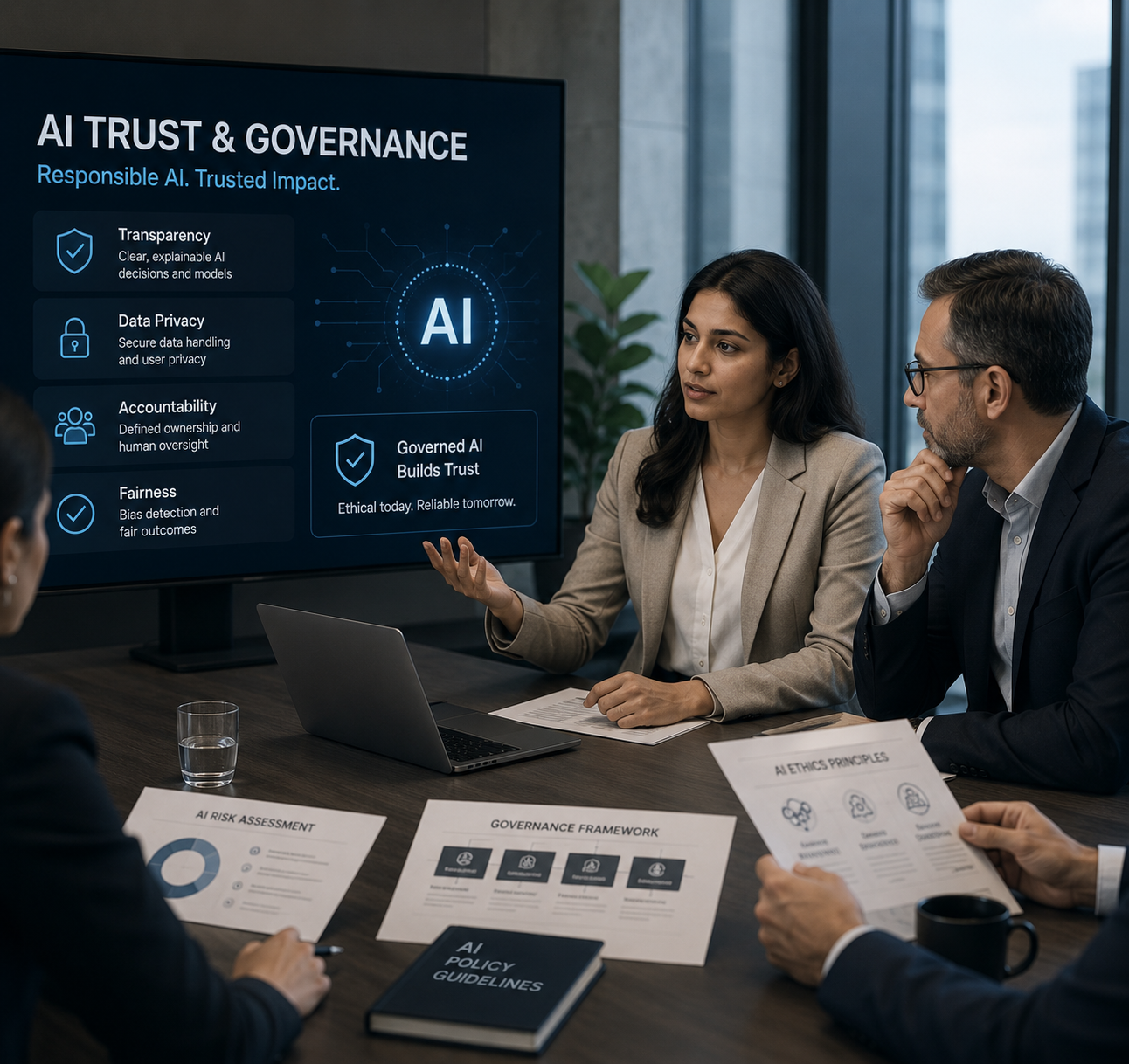
As AI moves into more decisions that affect customers, employees, and revenue, the question of how it is used becomes as important as what it can do. Boards, regulators, and customers are asking sharper questions. How was the model trained? What data does it use? How are errors handled? Who is accountable?
Organisations that treat AI governance as a strategic capability rather than a compliance afterthought are earning trust faster. They are also avoiding the reputational and regulatory risks that catch unprepared companies off guard.
Trend 8: AI Augmented Productivity Is Redefining What Output Means in the Future of Work
For decades, productivity meant output per hour. AI is forcing a broader definition. The new measure is leverage. How much value can one person, one team, or one organisation create with the same time and budget once AI is in the loop?
This redefinition has practical implications. Performance reviews, target setting, and resource planning all shift when a team that used to deliver one campaign a month can now deliver six. The companies that update their internal scoreboards to reflect this will allocate effort and reward in smarter ways.
Trend 9: The Talent Market Is Splitting — AI and the Future of Work Are Separating Leaders from Laggards
A clear divide is emerging between professionals who use AI deeply in their work and those who treat it as optional. The first group is producing more, learning faster, and getting promoted ahead of peers. The second group is finding their work pattern increasingly hard to defend.
This is not a coding skills question. The most valuable AI users are often not engineers. They are marketers, analysts, sales leaders, founders, consultants, and operators who built the habit of asking what AI can do for the next task in front of them.
Trend 10: Culture, Not Just Technology, Decides the Outcome of AI and the Future of Work
Of all the trends shaping AI and the future of work, this is the one that gets the least attention and matters the most. Two companies can buy the same tools, train on the same data, and hire similar talent. One will see real transformation. The other will see incremental improvement. The difference is culture.
Cultures that reward curiosity, fast experimentation, learning from failure, and sharing what works tend to absorb AI deeply. Cultures that punish mistakes, hoard information, and rely on hierarchy tend to underuse the same tools. Leaders who get this right are quietly building a long term advantage.
What Businesses Should Do Now to Prepare for AI and the Future of Work
If you lead a team, function, or company, the practical steps are clearer than the headlines suggest.
- Identify the three workflows in your function where AI can deliver real value in the next two quarters and run focused projects on them.
- Make AI literacy a baseline expectation across teams, not a specialist skill held by a few.
- Invest in your data foundation, because AI in production is only as good as the information it can reach.
- Redesign roles and processes deliberately, not just bolt AI onto what exists today.
- Treat governance and trust as part of the build, not a clean up exercise at the end.
- Reward people who teach others how to use AI well, since adoption compounds when knowledge spreads.
The companies that combine these moves will not just survive the shift. They will define what good looks like in their industry.
FAQs
What does AI and the future of work mean in practical terms?
It refers to how AI is reshaping how organisations operate, how teams are structured, how productivity is measured, and how individual roles evolve. It covers both day to day workflows and longer term shifts in skills, talent, and leadership.
Will AI replace most jobs in the future of work?
Most jobs will be reshaped rather than removed. The bigger story is the rise of AI augmented work, where humans remain in charge but use AI to handle the heavier and more repetitive parts of their roles.
Which trend in AI and the future of work matters most for business leaders right now?
The move from pilot to production. Organisations that have AI deeply embedded in real workflows are pulling ahead of those still running disconnected experiments.
How do we start if we are behind on AI and the future of work?
Pick two or three high value workflows, build focused AI projects around them, and use those wins to build internal confidence, capability, and momentum. Avoid trying to transform everything at once.
What role does culture play in AI and the future of work?
Culture often decides whether AI delivers real value or stalls. Curiosity, fast experimentation, learning from failure, and shared knowledge accelerate adoption. Hierarchy, blame, and information hoarding slow it down.
How should we think about governance in the context of AI and the future of work?
Build it into your AI work from day one. Decide who is accountable, what data is used, how errors are handled, and how the system is monitored. Trust, once lost, is expensive to rebuild.
Is your business genuinely ready for the future of work, or just keeping pace with the noise?
Which trend on this list will you act on this quarter before your competitors do?