

Building the right product has always been one of the hardest things a business can do. It requires a deep understanding of what customers actually want, how they use what you have already built, and where the gaps are between their expectations and their experience. Getting this wrong is expensive. Getting it right, consistently and quickly, is a genuine competitive advantage.
AI in product research is changing what is possible on all three fronts. It is helping teams gather faster insights from larger and more diverse sources, process feedback that would have previously gone unread, and make better product decisions with more confidence. This piece walks through how that works in practice and what it means for teams trying to build products that genuinely work for their customers.
Why AI in Product Research Changes the Game
Product research has always had a data problem. Not too little data, but too much of it arriving in too many places at once. App reviews, support tickets, in-app surveys, usability session recordings, social media mentions, sales call notes, and churn interviews all contain useful signals about how the product is performing. But no team has the time to process all of this manually and still build anything.
The result is that most product decisions get made on partial information. Teams act on the feedback that is loudest or most recent rather than the feedback that is most representative or most strategically important. AI in product research solves this by automating the processing and analysis work, freeing product teams to focus on interpretation and action.
The benefits compound over time. Teams that consistently base their decisions on complete, well-analysed product research build better products. They catch problems earlier, validate ideas before investing in them, and develop a feedback loop between customer experience and product development that drives continuous improvement.
Getting Faster Insights Through AI-Powered Feedback Analysis
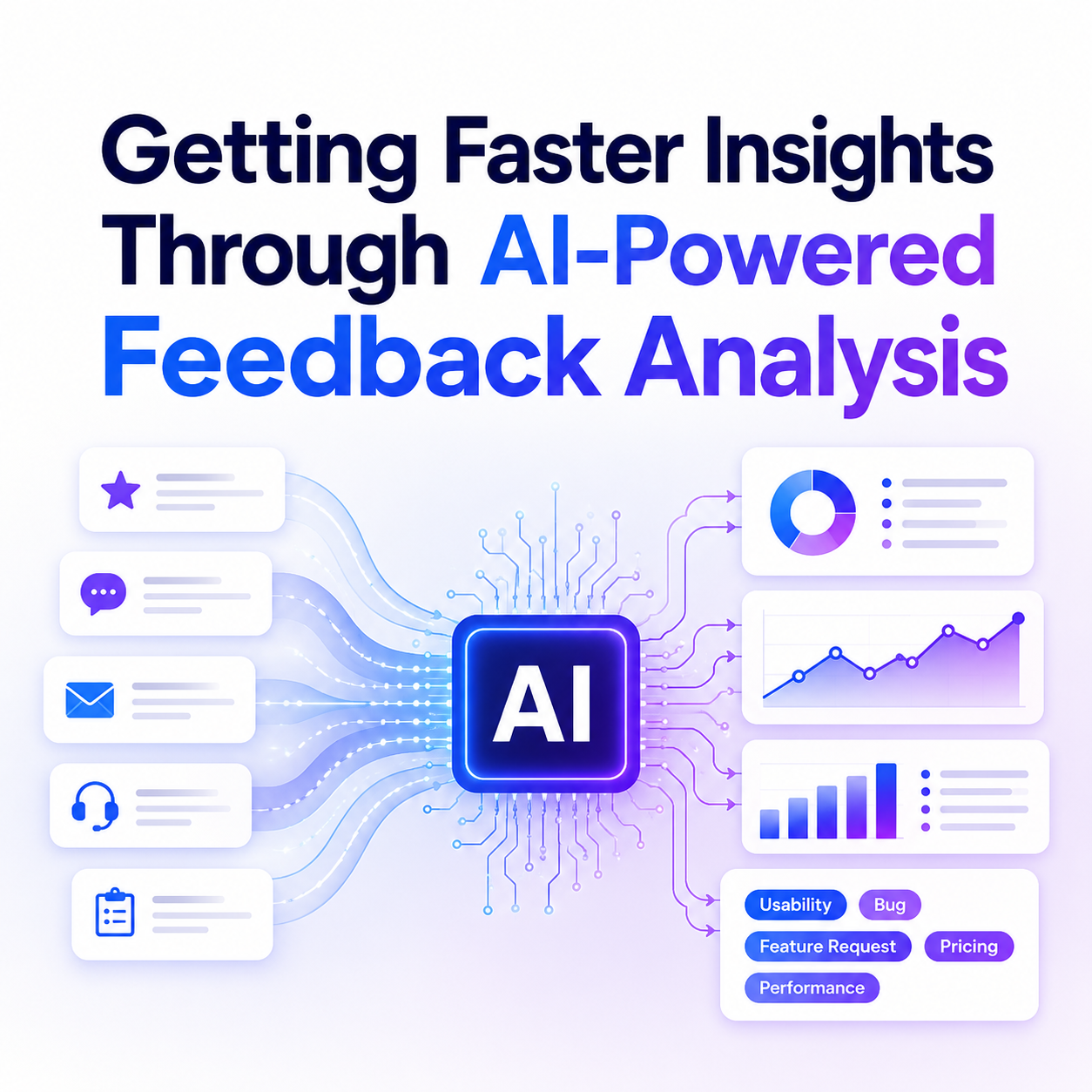
One of the most immediate and practical applications of AI in product research is the automated analysis of customer feedback. When AI tools can read, categorise, and summarise thousands of reviews, support transcripts, and survey responses in hours rather than days, the pace at which product teams can act on feedback changes fundamentally.
How AI Turns Feedback Volume Into Faster Product Insights
Natural language processing allows AI to read unstructured text and extract structured themes from it. A product team might have ten thousand app reviews spread across multiple platforms. Manually reading and coding these would take weeks. AI can process the same dataset in hours, producing a prioritised summary of the themes that appear most frequently and the issues that generate the strongest emotional response.
These faster insights do more than save time. They also reduce the selection bias that comes from only reading the feedback that happens to surface. When analysis is comprehensive rather than sampled, the picture it produces is more accurate, and the decisions made from it are more likely to be right.
Continuous Monitoring for Ongoing Product Research
Beyond processing historical feedback, AI in product research enables continuous monitoring of what customers are saying as they say it. Rather than waiting for a scheduled review cycle, product teams can receive alerts when sentiment around a specific feature changes, when a new complaint theme emerges, or when customers start praising something that was previously unremarkable.
This shift from periodic to continuous product research changes the posture of the team. Instead of reacting to problems after they have accumulated, teams can identify and address them while they are still manageable. The faster insights produced by continuous monitoring are often more valuable than the same insights delivered weeks later through a traditional research cycle.
AI in Product Research for Concept Testing and Feature Validation
Before building something new, product teams need to know whether it is worth building. Concept testing and feature validation are essential parts of good product research, but in their traditional form they are slow and expensive. AI is compressing both.
Faster Concept Testing With AI-Powered Product Research
AI-powered survey platforms can field concept tests to targeted audiences quickly, with adaptive questioning that digs beneath initial reactions to understand the reasoning behind them. Machine learning models can then identify which concepts perform strongest, which audience segments respond most positively, and what concerns need to be addressed before moving forward.
For product teams working in competitive or fast-moving categories, this ability to run rapid AI-powered product research before committing development resources is enormously valuable. It reduces the risk of building something customers do not actually want, and it builds organisational confidence in the direction being taken.
Using AI Product Research to Validate Before You Build
The best product teams use AI in product research not just to understand what customers think after the fact, but to test ideas before they are built. Rapid AI-assisted validation studies can tell you whether a proposed feature addresses a real problem, whether the solution resonates with the target audience, and whether the framing and positioning are landing as intended.
This kind of early-stage product research reduces waste and increases the proportion of development effort that goes toward things customers genuinely value. It also produces faster insights that teams can use to refine and sharpen ideas before they commit to building them.
Behavioural Analysis and Usability: AI Product Research in Action
Understanding how customers use a product in the real world is one of the most valuable inputs to good product decisions. Traditional usability research has been limited by the cost and logistics of running moderated sessions. AI is expanding what is possible in this area significantly.
Automated usability platforms powered by AI can now analyse session recordings at scale, identifying where users hesitate, where they get confused, and where they abandon tasks. Across hundreds of sessions, AI can surface patterns in user behaviour that would be invisible in a sample of five or ten participants. This makes usability-focused product research both faster and more reliable.
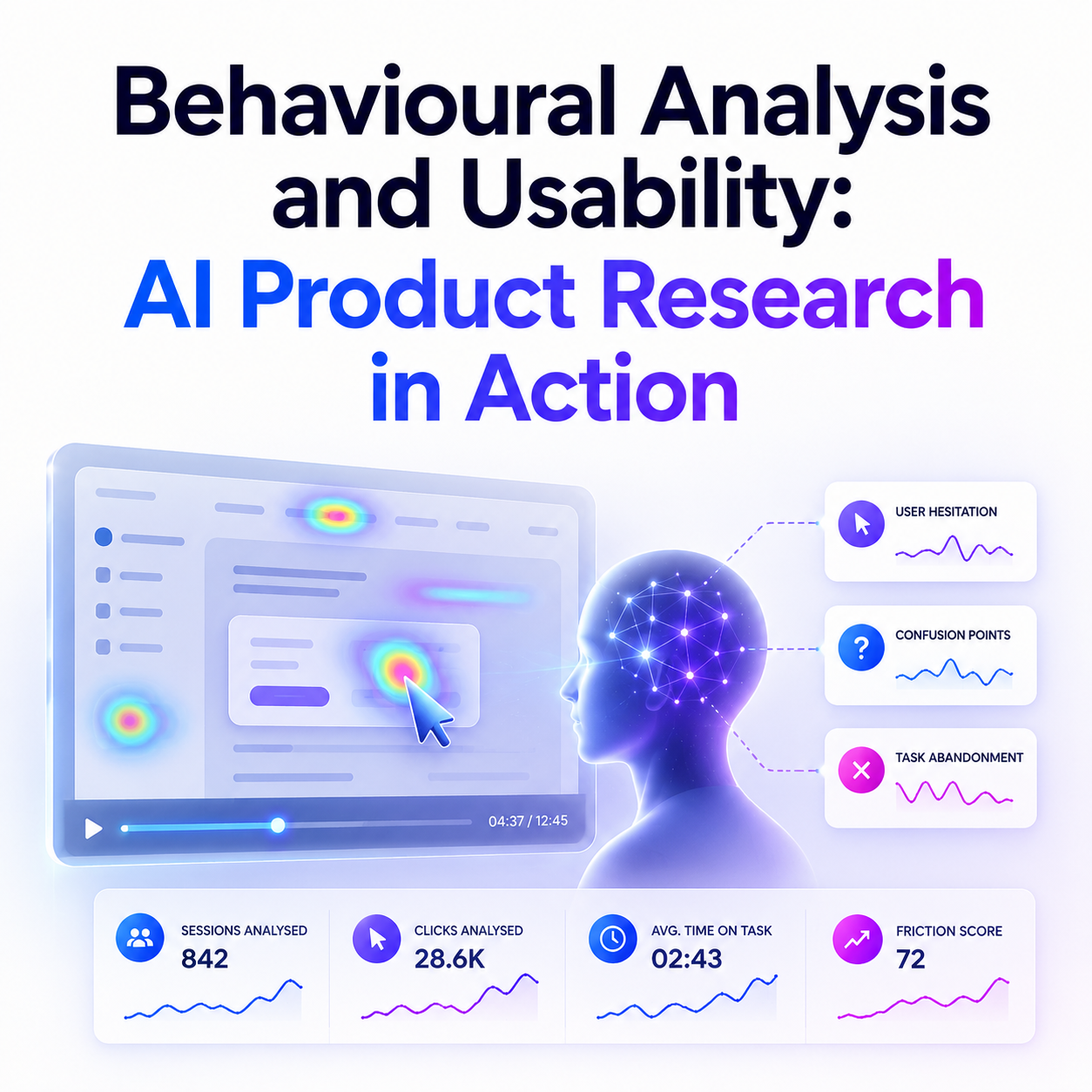
Behavioural analytics tools integrated with AI can also monitor in-product behaviour continuously, flagging anomalies and identifying friction points as they emerge. Product teams receive faster insights about how the product is performing in real conditions, rather than learning about problems only when they show up in support queues or churn data.
Making Better Product Decisions With AI Research
The connection between faster insights and better product decisions is not automatic. Speed is only valuable if the insights being produced are reliable and if teams have the processes in place to act on them. A few principles make the difference between AI in product research that changes outcomes and AI that just accelerates the production of reports no one reads.
Research questions still need to be well-framed. AI analysis produces better outputs when it is pointed at specific, clearly articulated questions. Teams that invest time in defining what they want to understand before running AI-powered product research tend to get outputs that are more useful and more actionable.
Human interpretation remains essential alongside AI-generated faster insights. AI can identify patterns and surface themes, but understanding why those patterns exist and what they mean strategically requires the contextual knowledge that experienced researchers and product leaders bring. The best results come from treating AI as a powerful assistant rather than a decision-maker.
Prioritisation frameworks matter. AI in product research will surface many findings. Having a clear framework for deciding which of them to act on, based on factors like the frequency of an issue, the seniority of the customers affected, and the strategic importance of the relevant part of the product, ensures that effort goes where it will have the most impact.
Frequently Asked Questions
What is AI in product research?
AI in product research refers to the use of artificial intelligence tools to gather, process, and analyse information about how products are performing, how customers are using them, and what improvements would deliver the most value. It includes automated feedback analysis, AI-powered concept testing, behavioural analysis, and competitive research.
How does AI help product teams get faster insights?
AI helps product teams get faster insights by automating the processing and analysis of large volumes of customer feedback and behavioural data. Tasks that would take human analysts days or weeks can be completed in hours with AI tools, meaning product teams can act on findings much sooner after data is collected.
Can AI in product research replace user interviews and usability testing?
Not entirely. User interviews and moderated usability sessions provide depth and context that automated tools cannot fully replicate, particularly for exploratory research. However, AI can complement these methods by enabling analysis at much larger scale and providing continuous monitoring between formal research exercises.
How do I prioritise the findings that AI product research surfaces?
Prioritisation should combine the frequency of a theme, the strength of feeling associated with it, and its strategic relevance to your business goals. AI provides the first two. The third requires human judgment about which improvements will have the greatest impact on the outcomes that matter most.
What data sources work best for AI-powered product research?
The most commonly used sources include app store reviews, in-product feedback surveys, customer support transcripts, usability session recordings, social media mentions, and behavioural analytics data. The most effective product research programmes typically combine several of these, since each captures a different type of signal about the customer experience.