

Every interaction a customer has with your brand shapes how they feel about it. Whether it is a social media post, a customer service conversation, an online review, or a product experience, each touchpoint contributes to your overall brand perception. In today's digital world, where customers openly share their opinions across multiple platforms, understanding these emotions has become more important than ever.
This is where brand sentiment analysis plays a crucial role.
Brand sentiment analysis helps businesses move beyond simply counting mentions or tracking engagement metrics. Instead, it uncovers how people actually feel about a brand. Are customers excited about your latest product launch? Are they frustrated with customer support? Do they trust your brand more than your competitors? These insights help businesses make informed decisions that strengthen customer relationships and improve overall brand reputation.
Traditional approaches to measuring brand perception often relied on surveys, focus groups, and manual analysis. While these methods remain valuable, they can be time consuming and may not capture the continuous flow of customer conversations happening across digital channels. Businesses today require faster, more scalable solutions that combine structured research with real time data analysis.
Artificial intelligence has transformed how organizations measure sentiment. AI powered market research platforms can analyze thousands of responses, customer comments, reviews, survey answers, and social conversations within minutes while identifying emotional tone, recurring themes, and emerging issues that might otherwise go unnoticed.
For enterprises managing multiple brands, markets, and research initiatives, AI also brings consistency to how sentiment is measured. Instead of relying solely on manual interpretation, organizations can standardize sentiment analysis across teams while maintaining high levels of accuracy and quality.
As an AI native market research platform, InsignAI enables organizations to automate research workflows while delivering deeper customer understanding through intelligent analytics. From questionnaire design and survey programming to text analytics, dashboards, and reporting, businesses can transform customer feedback into actionable insights within a unified ecosystem.
In this guide, we will explore what brand sentiment analysis is, why it matters, how it works, the challenges businesses face, and how AI is helping organizations measure and improve brand perception more effectively than ever before.
What Is Brand Sentiment Analysis?
Brand sentiment analysis is the process of identifying, measuring, and interpreting how customers feel about a company, product, or service based on the feedback they share.
Rather than focusing only on the number of conversations happening around a brand, sentiment analysis evaluates the emotional context behind those conversations. Every customer opinion typically falls into one of three categories:
- Positive sentiment
- Neutral sentiment
- Negative sentiment
For example, consider these customer comments:
Positive
"The new mobile app is incredibly easy to use. I finished my purchase in less than two minutes."
Neutral
"The product arrived yesterday as expected."
Negative
"Customer support never responded to my complaint."
Although all three comments mention the brand, each provides a completely different insight into customer experience.
Brand sentiment analysis combines qualitative understanding with quantitative measurement to identify patterns across thousands of customer interactions. Businesses can then determine:
- Overall customer satisfaction
- Brand reputation
- Consumer trust
- Product acceptance
- Service quality
- Emotional drivers behind purchasing decisions
Instead of reacting only when problems become visible, organizations can proactively monitor changing customer perceptions and respond before small issues become major reputation risks.
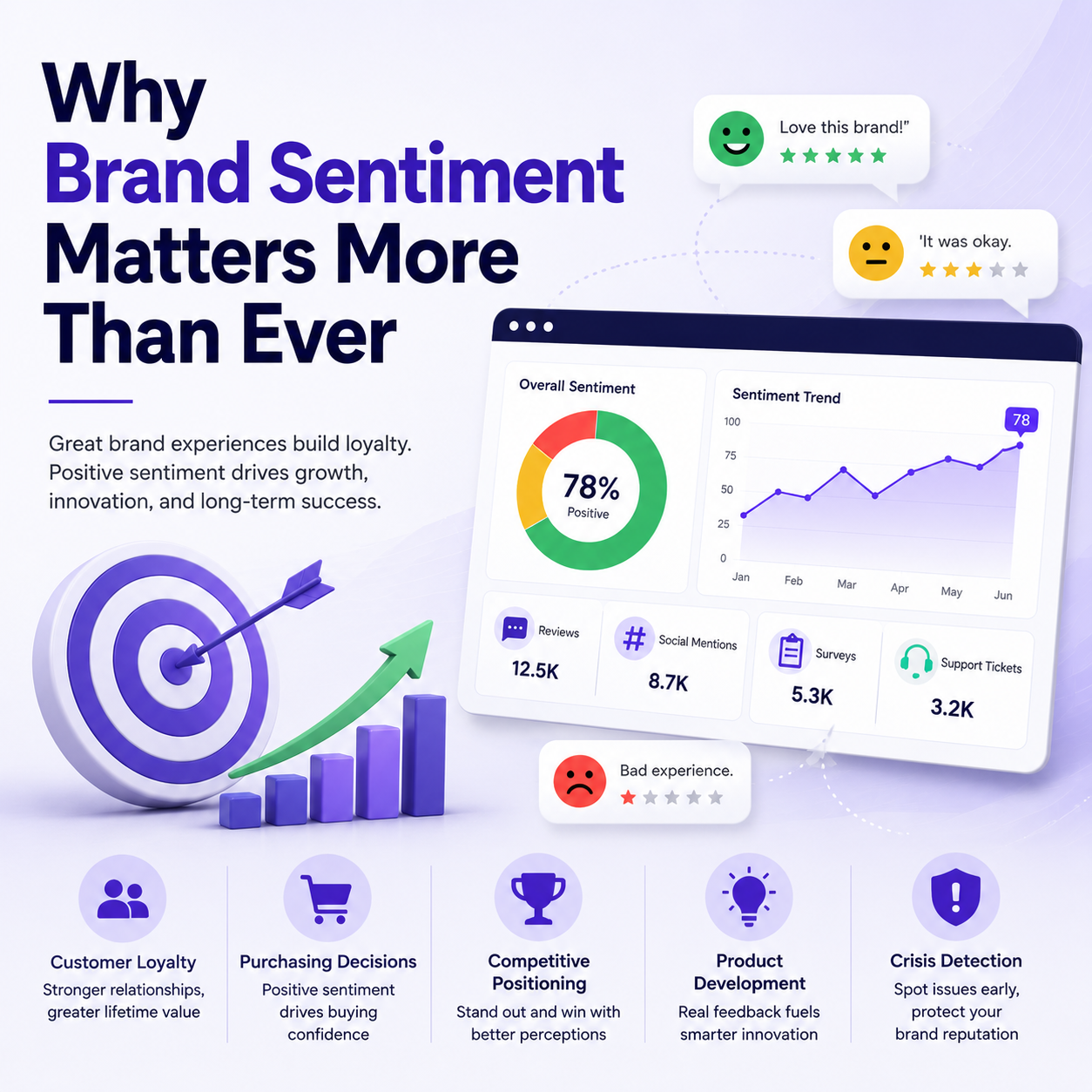
Why Brand Sentiment Matters More Than Ever
Customer expectations continue to evolve rapidly. Consumers now expect brands to respond quickly, deliver consistent experiences, and genuinely understand their needs.
A single negative experience can spread across multiple digital channels within hours, while positive customer experiences can significantly strengthen brand advocacy.
Brand sentiment influences nearly every business outcome, including:
Customer Loyalty
Customers who consistently have positive emotional experiences are far more likely to remain loyal, recommend the brand, and purchase repeatedly.
Strong sentiment contributes to:
- Higher customer retention
- Increased lifetime value
- Better referral rates
- Greater trust
Purchasing Decisions
Today's buyers rarely make purchasing decisions based solely on advertisements.
Instead, they evaluate:
- Online reviews
- Customer testimonials
- Social media discussions
- Independent recommendations
- Brand reputation
Positive sentiment directly impacts buying confidence.
Competitive Positioning
Two companies may offer similar products at similar prices.
The deciding factor often becomes customer perception.
Brands that consistently maintain positive sentiment typically experience:
- Stronger market positioning
- Higher customer preference
- Better brand recall
- Improved pricing power
Product Development
Customer feedback often contains valuable suggestions that inspire innovation.
Sentiment analysis helps organizations identify:
- Frequently requested features
- Common frustrations
- Product improvements
- Emerging customer needs
Instead of relying on assumptions, businesses can prioritize product decisions based on actual customer emotions.
Crisis Detection
Brand crises rarely happen overnight.
Most begin with small warning signs such as:
- Growing customer complaints
- Increasing negative reviews
- Declining satisfaction scores
- Repeated service issues
Early sentiment monitoring enables businesses to identify these warning signals before they become large scale reputation challenges.
Common Sources of Brand Sentiment Data
One of the biggest advantages of modern sentiment analysis is the ability to combine feedback from multiple customer touchpoints.
Each source contributes a unique perspective.
Customer Surveys
Surveys remain one of the most reliable methods for measuring customer sentiment because businesses can ask highly targeted questions.
Common survey metrics include:
- Customer Satisfaction (CSAT)
- Net Promoter Score (NPS)
- Customer Effort Score (CES)
- Brand perception studies
- Product feedback surveys
Unlike public online conversations, surveys allow researchers to explore the reasons behind customer opinions in much greater depth.
Online Reviews
Review platforms provide honest opinions from actual customers.
Reviews often reveal:
- Product quality perceptions
- Delivery experiences
- Customer service performance
- Purchase satisfaction
- Expectations versus reality
Analyzing review sentiment helps businesses identify recurring themes across thousands of customer experiences.
Social Media Conversations
Customers openly discuss brands on platforms such as LinkedIn, X, Instagram, Facebook, and Reddit.
These conversations provide valuable insights into:
- Public perception
- Campaign performance
- Product launches
- Brand awareness
- Customer engagement
AI powered sentiment analysis can process large volumes of social conversations in real time, allowing businesses to respond quickly to changing public opinion.
Customer Support Interactions
Support tickets, emails, live chats, and call transcripts contain some of the richest sources of customer sentiment.
These interactions often reveal:
- Service issues
- Customer frustrations
- Resolution quality
- Support agent performance
- Process improvements
When analyzed collectively, support conversations help organizations improve both customer experience and operational efficiency.
Website Feedback
Many organizations collect direct customer feedback through:
- Contact forms
- Website polls
- Product ratings
- Exit surveys
- Live chat interactions
Although individually these comments may seem small, together they provide valuable insights into customer expectations and pain points.
How AI Transforms Brand Sentiment Analysis
Traditional sentiment analysis often relied on manually reading customer feedback, categorizing responses, and identifying recurring themes. While this approach works for small datasets, it becomes increasingly difficult as businesses collect thousands of customer interactions every day across surveys, reviews, support tickets, and digital channels.
Artificial intelligence changes this by making sentiment analysis faster, more accurate, and scalable.
Rather than simply identifying whether a comment is positive or negative, AI can understand context, detect emotional patterns, group similar feedback, and highlight the issues that matter most to decision makers.
For example, imagine a retail brand launches a new product and receives over 15,000 customer comments within the first week.
Instead of spending weeks manually reviewing responses, AI can instantly identify:
- Overall customer sentiment
- Frequently mentioned product features
- Common complaints
- Positive experiences
- Regional differences
- Emerging trends
This allows businesses to take action while customer conversations are still evolving rather than reacting weeks later.
How AI Performs Brand Sentiment Analysis
Modern AI-powered research platforms follow a structured workflow that converts unstructured customer feedback into meaningful business insights.
Step 1: Collect Customer Feedback
The process begins by gathering feedback from multiple sources, including:
- Customer surveys
- Online reviews
- Social media conversations
- Customer support tickets
- Product ratings
- Website feedback
- Community forums
Combining these data sources provides a more complete picture of brand perception than relying on a single channel.
Step 2: Clean and Organize Data
Customer feedback often contains:
- Duplicate responses
- Spam
- Irrelevant comments
- Typographical errors
- Bot-generated content
Before sentiment analysis begins, AI automatically cleans and organizes the data to improve accuracy.
This ensures businesses make decisions based on reliable information rather than noisy datasets.
Step 3: Detect Sentiment
Natural Language Processing (NLP) enables AI to understand the emotional meaning behind written feedback.
Instead of focusing only on individual words, modern AI evaluates context.
For example:
"The product quality is excellent, but delivery took far too long."
A simple keyword-based system may classify this as positive because of the word "excellent."
AI understands that the overall feedback contains both positive and negative sentiment, allowing businesses to separately evaluate product satisfaction and delivery performance.
Step 4: Identify Themes
Once sentiment is classified, AI groups similar responses into common themes.
Examples include:
- Product quality
- Customer service
- Pricing
- Delivery
- Website experience
- Ease of use
- Product features
Instead of reading thousands of comments individually, businesses receive organized summaries highlighting the topics customers discuss most frequently.
Step 5: Generate Actionable Insights
The final stage transforms sentiment data into business recommendations.
Organizations can quickly identify:
- Which customer issues require immediate attention
- Which products generate the highest satisfaction
- Which campaigns improve brand perception
- Which customer segments are becoming less satisfied
- Which improvements will have the greatest business impact
Rather than producing static reports, AI enables continuous decision making.
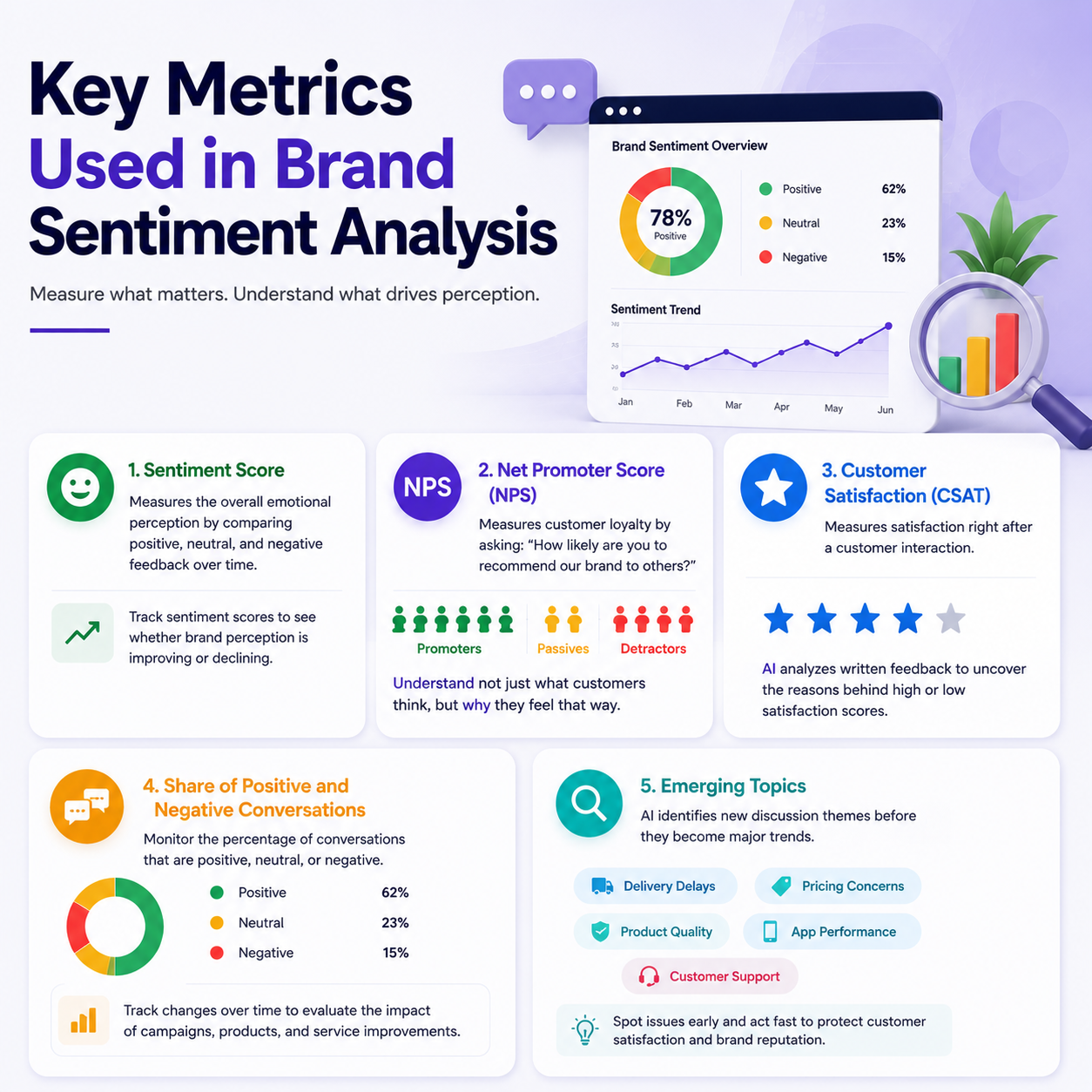
Key Metrics Used in Brand Sentiment Analysis
Sentiment analysis becomes more valuable when combined with measurable performance indicators.
Some of the most commonly tracked metrics include:
Sentiment Score
This measures the overall emotional perception of a brand by comparing positive, neutral, and negative feedback over a given period.
Tracking sentiment scores regularly allows organizations to understand whether brand perception is improving or declining.
Net Promoter Score (NPS)
NPS measures customer loyalty by asking a simple question:
"How likely are you to recommend our brand to others?"
Combining NPS with sentiment analysis helps businesses understand not only what customers think but also why they feel that way.
Customer Satisfaction (CSAT)
CSAT surveys measure satisfaction immediately after a customer interaction.
AI enhances CSAT by analyzing the written explanations customers provide alongside their ratings, revealing the reasons behind high or low satisfaction scores.
Share of Positive and Negative Conversations
Businesses can monitor the percentage of conversations that are:
- Positive
- Neutral
- Negative
Monitoring these changes over time helps evaluate the effectiveness of marketing campaigns, product launches, or customer service improvements.
Emerging Topics
AI continuously identifies new discussion themes before they become major trends.
For example, if customers suddenly begin mentioning delivery delays more frequently, businesses can investigate the issue before customer satisfaction declines significantly.
Common Challenges in Brand Sentiment Analysis
While sentiment analysis offers tremendous value, organizations often face several practical challenges.
Understanding Context
Human language is complex.
Comments containing sarcasm, humor, or mixed emotions can be difficult to interpret without advanced AI models.
For example:
"Fantastic. My order only arrived two weeks late."
Although the sentence begins with a positive word, the actual sentiment is negative.
Context-aware AI significantly improves interpretation accuracy.
Large Volumes of Data
Large enterprises receive thousands of customer interactions every day.
Manually reviewing this information is almost impossible.
AI enables organizations to process massive datasets consistently without sacrificing speed or quality.
Multiple Customer Channels
Customers rarely communicate through a single platform.
Some leave reviews.
Others contact support.
Many discuss experiences on social media.
Bringing all these conversations together into one unified view remains one of the biggest challenges for traditional research methods.
Integrated AI platforms solve this by consolidating multiple feedback sources into a single research ecosystem.
Maintaining Consistency
Different analysts may interpret customer comments differently.
AI helps standardize sentiment analysis by applying consistent evaluation criteria across every project, improving comparability between brands, markets, and research teams.
Conclusion
Brand perception is no longer shaped solely by advertising or marketing campaigns. It is influenced by every customer interaction, review, survey response, and online conversation. Businesses that actively measure these sentiments gain a deeper understanding of customer expectations and can make informed decisions that strengthen loyalty, improve products, and protect their reputation.
However, measuring sentiment manually is no longer practical in today's fast-paced digital landscape. Organizations need intelligent solutions that can process large volumes of structured and unstructured feedback while delivering actionable insights in real time.
An AI-powered market research platform like InsignAI enables businesses to go beyond simply tracking customer opinions. By automating questionnaire design, survey execution, data quality management, text analytics, dashboards, and reporting, organizations can transform customer feedback into meaningful business strategies faster and more consistently. With a dedicated Market Research LLM and an end-to-end research ecosystem, InsignAI empowers enterprises to measure brand sentiment accurately, identify emerging trends, and improve brand perception at scale.
As customer expectations continue to evolve, organizations that continuously listen, analyze, and act on customer sentiment will be better positioned to build stronger relationships, enhance customer experiences, and achieve long-term business growth.
Frequently asked questions
What is brand sentiment analysis?
Brand sentiment analysis is the process of evaluating customer opinions, emotions, and attitudes toward a brand by analyzing data from surveys, reviews, social media, customer support interactions, and other feedback channels. It helps businesses understand whether customer perception is positive, neutral, or negative.
Why is brand sentiment analysis important?
It helps businesses understand customer perception, identify emerging issues, improve customer satisfaction, strengthen brand reputation, and make data-driven decisions for marketing, product development, and customer experience.
How does AI improve brand sentiment analysis?
AI automates the analysis of large volumes of customer feedback, identifies emotions, detects recurring themes, uncovers hidden insights, and delivers results much faster than traditional manual analysis. It also improves consistency and accuracy across research projects.
What data sources are commonly used for sentiment analysis?
Businesses typically analyze:
- Customer surveys
- Online reviews
- Social media conversations
- Customer support tickets
- Website feedback
- Product ratings
- Community forums
Combining multiple data sources provides a more complete understanding of customer perception.
Can brand sentiment analysis help improve customer loyalty?
Yes. By identifying customer pain points, understanding expectations, and acting on feedback quickly, businesses can improve customer experiences, increase satisfaction, and strengthen long-term customer loyalty.
How does InsignAI help organizations measure brand sentiment?
InsignAI provides an AI-native, end-to-end market research platform that automates questionnaire design, survey programming, sampling, data quality, analytics, dashboards, and reporting. Its dedicated Market Research LLM helps enterprises analyze customer feedback efficiently while delivering consistent, high-quality insights.
Understand How Customers Truly Feel About Your Brand
Customer opinions are one of your most valuable business assets. With AI-powered brand sentiment analysis, you can uncover meaningful insights, respond to changing customer expectations, and make smarter business decisions backed by reliable research.
Discover how InsignAI helps enterprises measure brand perception faster, improve customer experiences, and transform feedback into actionable insights.