

Your customers are already telling you everything you need to know.
They're writing it in App Store reviews at 11pm after a frustrating session. They're typing it into Google reviews the morning after a great experience. They're leaving it in the comments of your product listing, in community forums, in the feedback box at the end of a long support call.
Most of it goes unread at any meaningful scale. A team member spot-checks reviews occasionally. Someone screenshots a particularly good or bad one into a Slack channel. Leadership sees a star rating average in a monthly report. And the actual content, the specific language customers use to describe what's working and what isn't, sits largely unprocessed.
This is where AI sentiment analysis changes the equation. Not by replacing the instinct that comes from reading customer reviews closely, but by making it possible to read all of them, consistently, at the scale where patterns actually become visible.
Why Reviews Are a Different Kind of Data
Survey responses are structured. Customers answer what you asked them. The insight is bounded by the questions you thought to include.
Reviews are different. Nobody prompted the customer to write one. Nobody handed them a scale or a set of response options. They chose to write something, about whatever felt worth writing about, in their own words, without the social pressure that survey contexts tend to create.
That makes reviews some of the most honest customer data that exists. The frustration in a three-star review is real frustration, not a diplomatically softened version of it. The enthusiasm in a five-star review reflects genuine experience, not the kind of mild satisfaction that gets rounded up to a high score on a structured survey.
It also makes reviews harder to analyze than survey data, because they're messy, inconsistent in length, written in different registers, and spread across platforms that don't talk to each other. AI sentiment analysis is what makes that messiness processable.
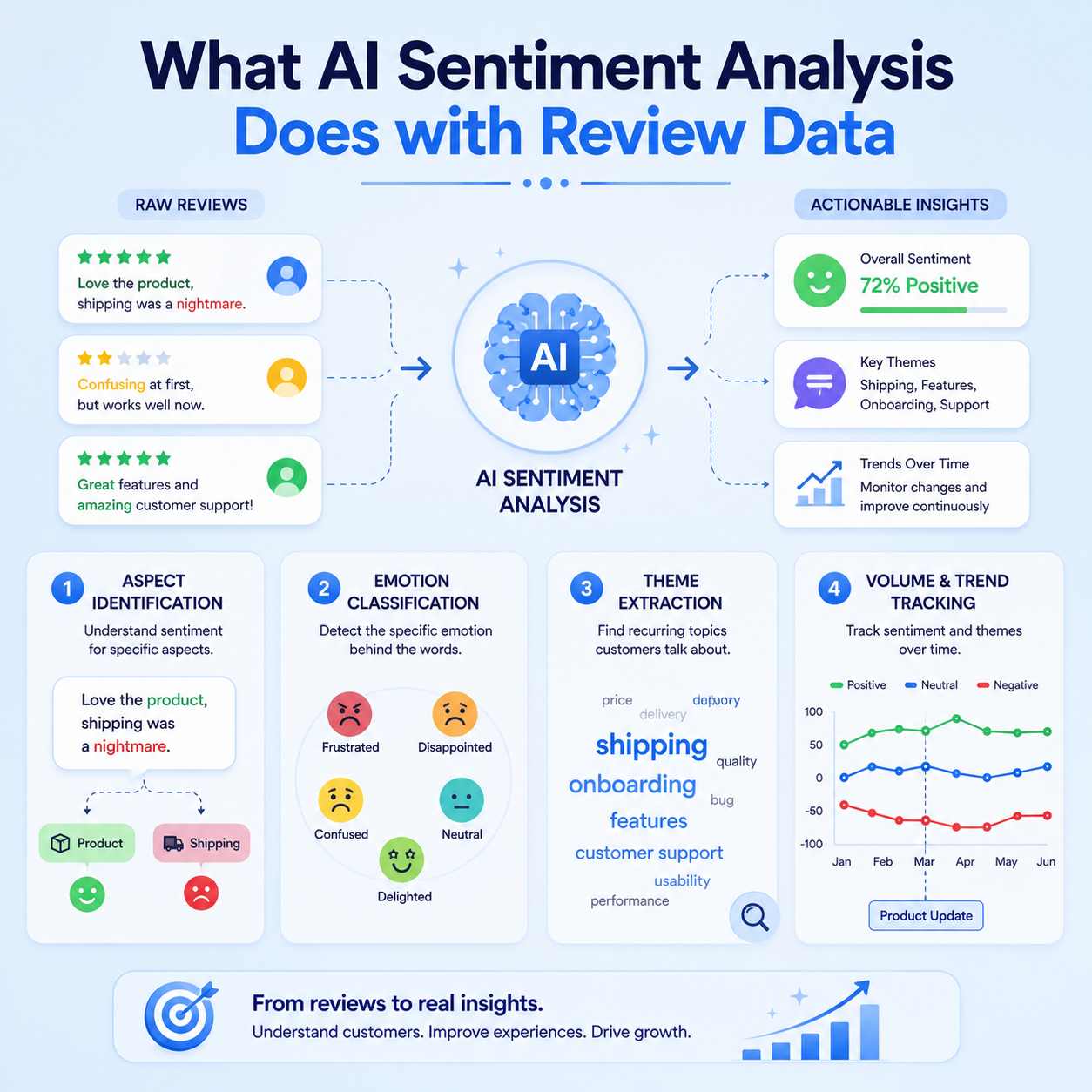
What AI Sentiment Analysis Does with Review Data
The basic function is reading the emotional tone of text and classifying it. Positive, negative, neutral. That's where the less capable tools stop, and it's also where most of the useful information gets lost.
The version worth using goes several layers deeper.
Aspect identification. A review that says "love the product, shipping was a nightmare" is not simply mixed sentiment. It's positive sentiment directed at one specific aspect of the experience and negative sentiment directed at another. AI sentiment analysis that reads at the aspect level tells you which parts of the business are generating which kinds of feedback, not just what the overall emotional temperature is.
Emotion classification. Negative sentiment covers a lot of ground. A frustrated customer and a disappointed customer are both negative, but they're in different emotional states that call for different responses. A confused customer often doesn't even sound negative on the surface, which is why basic sentiment tools miss them. AI sentiment analysis that classifies by emotion type produces signal that's specific enough to act on.
Theme extraction. Across hundreds or thousands of reviews, certain topics come up repeatedly. Shipping speed. Onboarding complexity. A specific feature that delights or frustrates. AI sentiment analysis finds these themes without requiring someone to read every review and manually code what they're about. The themes surface from the data rather than from a predetermined coding frame.
Volume and trend tracking. A single review is an anecdote. Ten reviews about the same issue is a pattern. A thousand reviews over six months, with AI sentiment analysis tracking the themes and emotional tone over time, is a strategic asset. You can see when sentiment around a specific aspect of the product started shifting, whether it followed a product update, and whether it's getting better or worse.
Where Reviews Carry Signal That Other Data Sources Miss
Reviews capture something that surveys, NPS programs, and customer interviews tend to soften: the real-time emotional response to an experience.
A customer who had a terrible onboarding experience might score you a six on an NPS survey sent three weeks later, after the frustration has faded a bit. They might write a two-star review the same evening it happened, when the frustration is still sharp. The review captures the emotion at its actual intensity. The survey captures a retrospective average.
This matters for a few specific use cases.
Product launch monitoring. When a new feature ships, review sentiment moves fast. Customers who encounter problems write about them immediately. AI sentiment analysis on reviews in the days and weeks following a launch gives product teams signal on how the feature is landing before the data shows up in slower-moving trackers.
Competitive intelligence. Customers who write reviews often compare. "I switched from X and this is so much better at Y" or "X's version of this feature works differently" shows up in review language at meaningful frequency. AI sentiment analysis extracts these comparisons at scale and turns them into structured competitive intelligence without requiring a separate research project.
Uncovering unknown issues. Surveys only find what you thought to ask about. Reviews surface what customers thought was worth mentioning, including problems your team didn't know existed. The theme that shows up in 8% of reviews about a specific edge case in your product is invisible in survey data if no one knew to ask about it. AI sentiment analysis on reviews finds it.
Reputation management. Review sentiment that's deteriorating in a specific category, one-star reviews clustering around a particular product line or customer type, signals a reputation risk before it compounds into something that affects acquisition. Catching it in the review data early is considerably less expensive than addressing it after it has moved the star rating average.
The Platforms That Matter Most for Review Sentiment Analysis
Review data is spread across multiple platforms, each with different audiences and different behavioral norms for leaving feedback.
App stores. App Store and Google Play reviews come from active users who felt strongly enough to rate. Negative reviews here are often specific and actionable: the crash that happens on a particular device, the feature that stopped working after an update, the onboarding step that consistently confuses new users.
Google reviews. For businesses with a physical or service dimension, Google reviews carry high visibility and often reflect the end-to-end customer experience rather than a specific product interaction.
Industry-specific platforms. G2, Trustpilot, Capterra, TripAdvisor, and similar category-specific platforms attract reviewers who are often comparing options and writing for an audience of potential buyers. The language tends to be more considered and comparative, which makes it particularly useful for understanding how you're positioned against alternatives.
Retailer and marketplace reviews. For product businesses, Amazon and similar platforms generate high review volume with a wide range of specificity. AI sentiment analysis on retailer reviews often surfaces packaging and delivery feedback that doesn't reach customer service and product quality signals that show up here before they show up anywhere else.
The most complete picture comes from integrating across sources rather than analyzing each one separately. A customer who had a negative experience might leave a two-star App Store review and also write a Google review. Unified AI sentiment analysis across platforms treats these as one customer signal rather than two separate data points.
What Good Review Sentiment Analysis Actually Produces
The output isn't a sentiment score. A sentiment score is where the analysis starts, not where it ends.
What you should be walking away with from a well-executed review sentiment analysis program:
A ranked view of the aspects of the customer experience generating the most positive and most negative language, with volume and trend data attached to each.
An emotional breakdown of the negative feedback: how much is frustration, how much is disappointment, how much is confusion. Each of these points toward a different kind of intervention.
Theme clusters that surface the specific topics customers write about most, including the ones your team wasn't monitoring because you didn't know they mattered.
Trend lines that show whether sentiment on specific aspects is improving or deteriorating, and roughly when shifts occurred.
Competitive signals extracted from comparative language in reviews: what customers say you do better than alternatives, and where they say you fall short.
That's the difference between review monitoring and review intelligence. Monitoring tells you what your star rating is. Intelligence tells you what's driving it, which segments are most affected, and what would need to change to move it.
Frequently Asked Questions
1. What is AI sentiment analysis and how does it apply to reviews?
AI sentiment analysis is the use of natural language processing to read text and identify the emotional tone and content behind it. Applied to reviews, it means processing large volumes of customer-written feedback to classify sentiment, identify which aspects of the experience the sentiment is directed at, extract recurring themes, and track how all of this changes over time. The AI reads what customers wrote and turns it into structured, measurable data that can inform decisions rather than just sitting in a review dashboard as raw text.
2. How is AI sentiment analysis different from simply tracking star ratings?
Star ratings tell you the direction of customer feeling but nothing about its content. A product with a 3.8 average could be receiving that score because most customers are mildly satisfied, or because half are giving five stars and the other half are giving one star for a very specific reason. AI sentiment analysis on the review text tells you which situation you're in, what the negative reviews are actually about, whether the issue is concentrated in a specific customer segment or product category, and whether it's getting better or worse over time. The rating is the signal. The text is the explanation.
3. Can AI sentiment analysis handle reviews across multiple platforms simultaneously?
Yes, and that's where the most complete picture comes from. Reviews on the App Store, Google, Trustpilot, and Amazon don't follow the same conventions or attract the same reviewer profiles. Analyzing each platform separately gives you partial pictures. A unified AI sentiment analysis framework that ingests from multiple sources and applies consistent classification logic across all of them produces a more accurate and complete view of overall customer sentiment than any single-source analysis can provide.
4. How much review volume is needed for AI sentiment analysis to be useful?
AI sentiment analysis produces accurate classifications at the individual review level regardless of volume. Where volume matters is in the reliability of theme and trend analysis. Identifying that a specific issue appears in 12% of reviews requires enough reviews to distinguish that 12% from random variation. For most businesses, a few hundred reviews per platform is enough to start surfacing meaningful themes. For trend analysis over time, consistency of volume matters more than the absolute number.
5. How does AI sentiment analysis handle fake or incentivized reviews?
This is a real data quality concern, particularly on platforms with known fake review problems. AI sentiment analysis can flag reviews that show unusual patterns: generic language that doesn't reference specific product details, response patterns that cluster in unusual time windows, or text that reads more like marketing copy than genuine customer experience. These signals don't definitively identify fake reviews, but they identify candidates for closer scrutiny before they're allowed to skew the analysis.
InsignAI is a full-stack, AI-native market research platform with a dedicated Market Research LLM, built to turn the reviews your customers are already writing into intelligence your team can act on.