

Every day, millions of people share their opinions about products on social media. They post reviews, discuss new launches, compare brands, recommend products to friends, and openly express what they like or dislike. Unlike traditional surveys, these conversations happen naturally, offering businesses an authentic view of customer perceptions.
For product teams, this continuous stream of conversations is a valuable source of market intelligence. It reveals how customers react to existing products, highlights unmet needs, uncovers emerging trends, and identifies opportunities for innovation. However, manually tracking thousands of conversations across multiple platforms is nearly impossible.
This is where social media sentiment analysis becomes essential.
Using artificial intelligence, businesses can analyze vast amounts of social media data in real time, identify customer emotions, detect recurring themes, and transform unstructured conversations into actionable product insights. Rather than relying solely on surveys or focus groups, organizations can complement traditional research with real-world customer opinions shared across digital platforms.
Modern AI-native research platforms such as InsignAI enable enterprises to integrate AI-powered text analytics into their research workflows, helping organizations convert large volumes of customer conversations into faster, more reliable business decisions.
In this article, we explore how social media sentiment analysis supports product research, why it matters for modern businesses, and how AI helps organizations build products customers genuinely want.
What Is Social Media Sentiment Analysis?
Social media sentiment analysis is the process of using artificial intelligence and natural language processing to evaluate the opinions, emotions, and attitudes expressed in social media conversations.
Instead of simply counting mentions or tracking hashtags, sentiment analysis determines how people actually feel about a product, feature, campaign, or brand.
Typically, customer conversations are categorized as:
- Positive
- Negative
- Neutral
- Mixed sentiment
Modern AI goes further by identifying emotions such as:
- Excitement
- Satisfaction
- Frustration
- Disappointment
- Trust
- Confusion
This deeper emotional understanding helps product teams understand not only what customers are discussing but also why they feel the way they do.
For example, a product may receive thousands of mentions after launch. While the volume of conversations appears positive, sentiment analysis may reveal that many users are actually frustrated by a complicated setup process. Without sentiment analysis, businesses might overlook this critical insight.
Why Social Media Matters in Product Research
Traditional market research remains valuable, but it often captures customer opinions only at specific points in time.
Social media offers something different.
It provides continuous, unsolicited feedback from real customers discussing their experiences without being prompted by a survey.
Customers regularly share opinions on platforms such as:
- X
- YouTube
- Online communities
- Brand discussion forums
These conversations reveal:
- First impressions
- Product expectations
- Feature requests
- Buying motivations
- Customer frustrations
- Competitive comparisons
Because these discussions happen naturally, they often provide richer insights than structured questionnaires alone.
When combined with traditional research methods, social media analysis creates a more complete understanding of customer behavior.
Challenges of Analyzing Social Media Manually
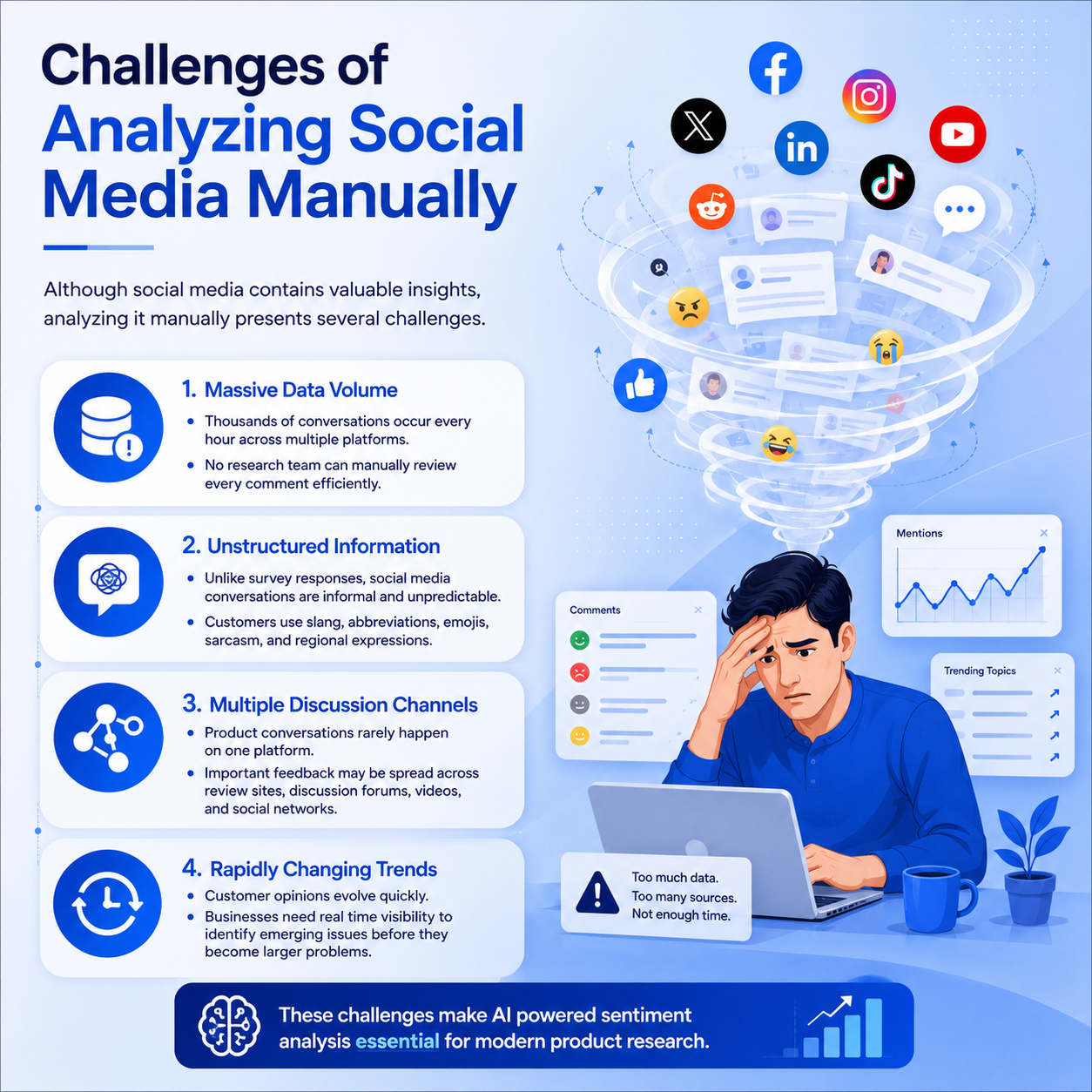
Although social media contains valuable insights, analyzing it manually presents several challenges.
Massive data volume
Thousands of conversations occur every hour across multiple platforms.
No research team can manually review every comment efficiently.
Unstructured information
Unlike survey responses, social media conversations are informal and unpredictable.
Customers use slang, abbreviations, emojis, sarcasm, and regional expressions.
Multiple discussion channels
Product conversations rarely happen on one platform.
Important feedback may be spread across review sites, discussion forums, videos, and social networks.
Rapidly changing trends
Customer opinions evolve quickly.
Businesses need real time visibility to identify emerging issues before they become larger problems.
These challenges make AI powered sentiment analysis essential for modern product research.
How AI Improves Social Media Sentiment Analysis
Artificial intelligence enables businesses to analyze social media conversations at a scale that manual research cannot achieve.
Instead of reading thousands of posts individually, AI automatically organizes customer feedback into meaningful insights.
Understands context
Modern AI understands language in context rather than relying solely on keywords.
For example:
"This update looked promising, but it made the app slower."
Although the sentence begins positively, AI correctly identifies the overall sentiment as negative because of the customer's experience.
Detects recurring themes
AI groups conversations around common topics such as:
- Product quality
- User experience
- Pricing
- Packaging
- Performance
- Customer service
- Delivery
This allows researchers to identify the most discussed issues quickly.
Tracks sentiment over time
Businesses can monitor whether customer perception improves or declines after:
- Product launches
- Feature updates
- Marketing campaigns
- Pricing changes
Continuous monitoring helps organizations measure the real impact of business decisions.
Identifies emerging product opportunities
AI highlights recurring feature requests and unmet customer needs.
When thousands of customers mention similar improvements, product teams gain evidence for future development priorities.
How Social Media Sentiment Analysis Improves Product Research
Social media sentiment analysis supports nearly every stage of the product development lifecycle.
Discover customer needs earlier
Customers often discuss problems before companies formally research them.
Analyzing these conversations helps businesses identify market gaps and develop products that address genuine customer challenges.
Validate product concepts
Before launching a new product, organizations can evaluate public conversations around similar products or industry trends.
This helps estimate customer demand and identify potential concerns.
Improve existing products
Customer complaints frequently reveal opportunities for product improvements.
Instead of relying only on support tickets, businesses gain a broader understanding of customer experiences across digital channels.
Measure product launch success
After introducing a new product, sentiment analysis measures public reaction in real time.
Product teams can quickly determine:
- Which features customers appreciate
- Which issues require immediate attention
- Whether customer perception aligns with business expectations
Benchmark against competitors
Social listening also provides competitive intelligence.
Businesses can compare customer sentiment across competing products to understand strengths, weaknesses, and opportunities for differentiation.
Turning Social Conversations into Business Insights
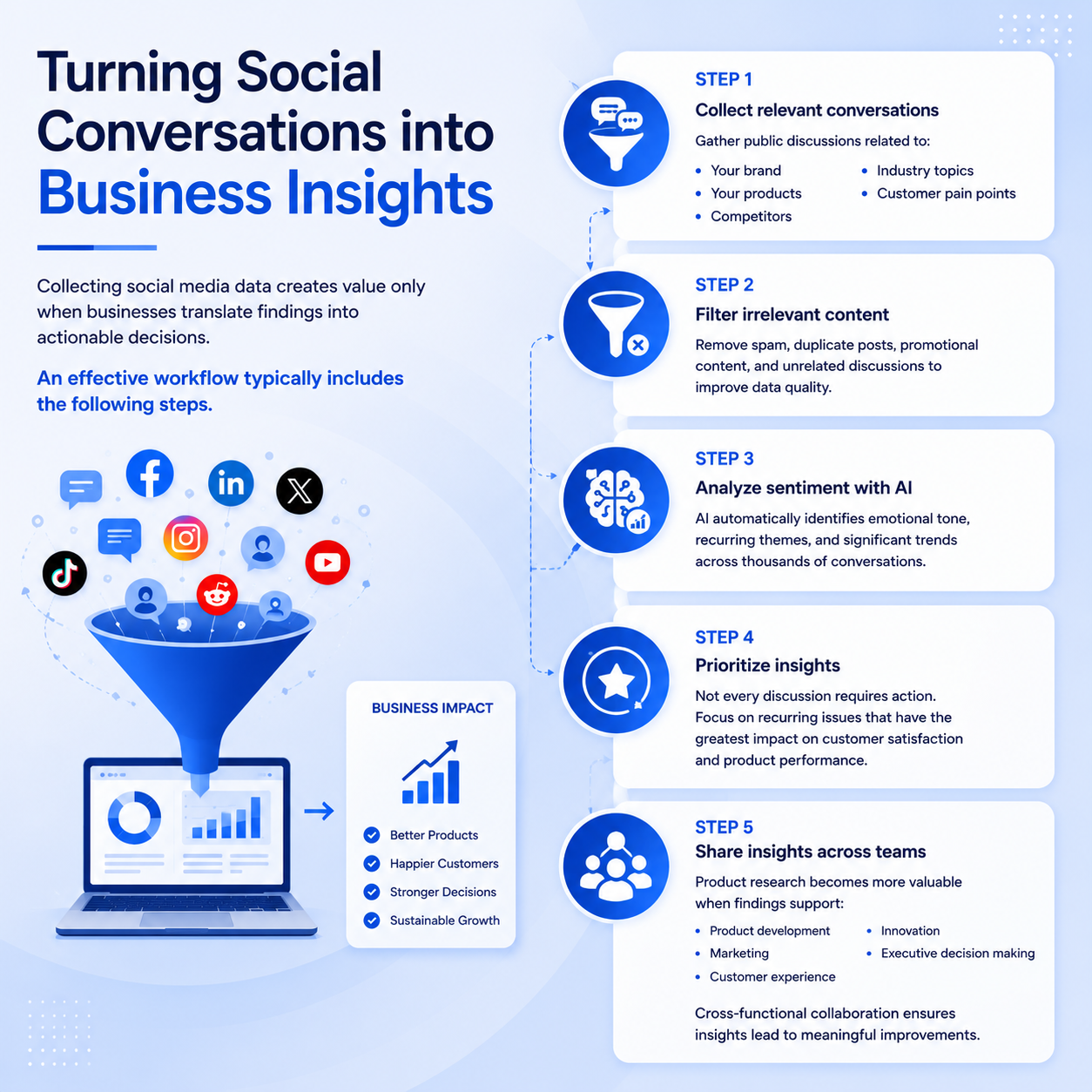
Collecting social media data creates value only when businesses translate findings into actionable decisions.
An effective workflow typically includes the following steps.
Step 1: Collect relevant conversations
Gather public discussions related to:
- Your brand
- Your products
- Competitors
- Industry topics
- Customer pain points
Step 2: Filter irrelevant content
Remove spam, duplicate posts, promotional content, and unrelated discussions to improve data quality.
Step 3: Analyze sentiment with AI
AI automatically identifies emotional tone, recurring themes, and significant trends across thousands of conversations.
Step 4: Prioritize insights
Not every discussion requires action.
Focus on recurring issues that have the greatest impact on customer satisfaction and product performance.
Step 5: Share insights across teams
Product research becomes more valuable when findings support:
- Product development
- Marketing
- Customer experience
- Innovation
- Executive decision making
Cross-functional collaboration ensures insights lead to meaningful improvements.
Real World Applications Across Industries
Organizations across industries use social media sentiment analysis to strengthen product research.
Consumer Electronics
Technology companies analyze customer discussions following software updates to identify usability issues and prioritize future improvements.
Retail
Retail brands monitor product reviews and social conversations to understand customer preferences and improve merchandise planning.
Automotive
Manufacturers evaluate customer reactions to new vehicle features, safety technologies, and overall driving experiences.
Consumer Goods
Brands identify emerging lifestyle trends and changing customer expectations before introducing new products.
Healthcare
Healthcare organizations monitor patient discussions to better understand service experiences and public perception while respecting privacy and compliance requirements.
Across industries, sentiment analysis helps organizations make product decisions supported by real customer evidence rather than assumptions.
Why AI Native Research Platforms Deliver Better Results
General purpose AI tools can summarize online conversations, but product research requires deeper research expertise.
Organizations need platforms that combine AI with structured research methodologies, data quality controls, and enterprise reporting capabilities.
InsignAI delivers an end-to-end research ecosystem that supports questionnaire design, survey programming, sampling, AI driven text analytics, dashboards, and reporting within a single platform. This integrated approach enables enterprises to transform customer conversations into standardized, scalable research insights while reducing manual effort and improving consistency.
Instead of treating social media as isolated feedback, businesses can combine social listening with surveys, interviews, and quantitative research to gain a complete view of customer sentiment.
Best Practices for Social Media Sentiment Analysis
Businesses can maximize the value of sentiment analysis by following these best practices.
- Monitor conversations continuously rather than only during product launches.
- Combine social media insights with survey and customer research data.
- Analyze both sentiment and recurring discussion themes.
- Compare customer sentiment across competitors.
- Validate AI findings with experienced research professionals for strategic decision making.
- Share insights regularly across product, marketing, and customer experience teams.
- Track long-term sentiment trends instead of focusing only on short-term spikes.
These practices help organizations develop products based on evolving customer expectations rather than isolated opinions.
Conclusion
Social media has become one of the richest sources of customer intelligence available today. Every conversation, review, recommendation, and complaint provides valuable clues about customer expectations, product performance, and emerging market trends.
However, the true value of these conversations lies in the ability to analyze them at scale.
Social media sentiment analysis enables businesses to understand customer emotions, uncover recurring issues, identify innovation opportunities, and make faster, evidence-based product decisions. By combining artificial intelligence with advanced research methodologies, organizations can transform unstructured online conversations into meaningful business intelligence.
AI native research platforms like InsignAI help enterprises move beyond basic social listening by integrating sentiment analysis into the broader research lifecycle, enabling faster insights, improved consistency, and more informed product strategies.
As customer expectations continue to evolve, organizations that actively listen to social conversations and translate them into action will be better positioned to develop products that truly meet market needs.
Turn Social Conversations into Smarter Product Decisions
Customer opinions are already shaping your market. The question is whether your business is capturing those insights effectively.
Discover how InsignAI helps organizations combine AI powered sentiment analysis with end-to-end market research to transform social media conversations into actionable product intelligence.
Frequently asked questions
What is social media sentiment analysis?
Social media sentiment analysis uses AI to evaluate customer opinions shared on digital platforms and identify whether conversations express positive, negative, neutral, or mixed emotions.
Why is social media useful for product research?
Social media provides authentic, real-time customer conversations that help businesses understand product experiences, feature requests, and emerging market trends.
How does AI improve sentiment analysis?
AI processes large volumes of unstructured conversations, detects emotions, identifies recurring themes, and delivers actionable insights much faster than manual analysis.
Can sentiment analysis support competitor research?
Yes. Businesses can compare customer sentiment across competing products to understand market positioning, identify weaknesses, and uncover opportunities for differentiation.
How does InsignAI support social media sentiment analysis?
InsignAI combines AI powered text analytics with end-to-end market research capabilities, helping enterprises analyze customer conversations, standardize research workflows, and generate faster, data-driven product insights.