

Your brand has a reputation problem. You just don't know it yet.
That's not a dramatic opener. It's the actual situation for most businesses running without a real-time view of what customers are saying about them on social media. Something shifts, a product update lands badly, a competitor makes a move that reframes how people think about your category, a customer service interaction goes sideways and gets screenshot. The conversation starts. It builds. By the time someone on your team notices, the narrative has already formed.
Social media doesn't wait for your quarterly brand tracker. It doesn't schedule feedback for convenient review cycles. It moves in real time, which means brand reputation intelligence that arrives six weeks late isn't intelligence. It's a post-mortem.
Social media sentiment analysis changes that. It gives brands a continuous, structured read on what customers are saying, how they're saying it, and where the emotional tone is heading before it becomes a crisis or an opportunity that was missed.
What Social Media Sentiment Analysis Actually Measures
Social media is not a single data source. It's a collection of platforms with different behavioral norms, different audience profiles, and different kinds of language that require different calibration to read accurately.
A tweet is not a Facebook comment is not a Reddit thread is not a LinkedIn post. The emotional register differs. The level of specificity differs. The audience composing the content differs. A brand complaint on Twitter tends to be sharp and public. The same frustration expressed in a Reddit community thread tends to be detailed and comparative. A positive LinkedIn mention tends to be professional and restrained in a way that makes it easy to underread.
Social media sentiment analysis processes all of these, consistently, applying the same analytical framework across platforms with different norms. What comes out is a unified view of brand sentiment across channels rather than a separate read for each one that has to be manually assembled.
The specific things it measures:
Volume. How much are people talking about your brand? A spike in mention volume is itself a signal, regardless of sentiment direction. A sudden increase in brand mentions could mean something very good happened or something very bad happened. Sentiment tells you which.
Tone. At the aggregate level, is the conversation trending positive, negative, or neutral? This is the baseline. It's also where the less capable tools stop.
Emotion type. What specific emotions are driving the tone? Frustration and disappointment are both negative, but they reflect different customer situations and require different responses. A frustrated customer has a specific grievance. A disappointed customer has a gap between expectation and reality. Treating them identically misses the distinction that makes intervention possible.
Themes. What are people actually talking about? Mentions of your brand cluster around topics: a specific product feature, a recent campaign, a service interaction, a pricing change. Knowing the volume and sentiment direction of each theme tells you what's driving the overall picture.
Velocity. How fast is a theme or sentiment shift moving? A slow-building negative trend around a product issue is a different operational situation from a fast-moving spike in negative sentiment following a specific event. Velocity tells you how urgently you need to respond.
Why This Matters for Brand Reputation Specifically
Brand reputation is slow to build and fast to lose. The asymmetry is well understood in theory and consistently underestimated in practice, because the mechanisms that erode reputation aren't always visible until they've already done meaningful damage.
Social media is where reputation gets made and unmade in real time. A customer who had a genuinely bad experience with your product and writes about it in detail on Twitter reaches that person's entire following instantly. If it resonates, it gets shared. If it resonates enough, it surfaces in industry conversations and media coverage. None of this is predictable from a quarterly brand tracker.
Social media sentiment analysis with InsignAI gives brands a continuous read on where reputation stands and how it's moving, across every platform where customers are talking, without requiring a team to manually monitor every channel.
The specific reputation use cases where this matters most:
Early warning. A spike in negative sentiment around a specific theme, caught early, is addressable. The same spike caught six weeks later, after it has shaped how a significant portion of your target audience thinks about the brand, is a recovery project. Real-time sentiment monitoring gives brands the early warning that periodic research cannot.
Campaign monitoring. When a campaign launches, the social response tells you immediately whether the creative is landing the way you intended. Positive sentiment around the intended brand attributes means the campaign is working. Negative sentiment, or sentiment that's attaching to the wrong attributes, means something needs adjustment before the media spend runs its full course.
Crisis detection and response. Not every crisis announces itself clearly. Sometimes it starts as an uptick in negative sentiment around a specific topic that looks like normal variance until it doesn't. Sentiment analysis with consistent trend monitoring distinguishes normal variance from an emerging pattern early enough to inform a response rather than a reaction.
Competitor context. What customers are saying about your competitors on social media is part of the brand reputation picture. Social media sentiment analysis that captures comparative mentions, customers who discuss your brand in relation to alternatives, gives you competitive intelligence that passive monitoring misses.
The AI Layer: What Makes It More Than Monitoring
Social media monitoring, tracking mentions and collecting them in a dashboard, has existed for years. The AI layer is what turns monitoring into intelligence.
Here's what AI sentiment analysis does that basic monitoring doesn't.
It reads context, not just keywords. Brand mentions don't always include your brand name. Customers use abbreviations, refer to specific products, describe experiences without naming the company directly. AI trained on brand-specific language patterns catches these indirect mentions that keyword-based monitoring misses entirely.
It understands sarcasm and irony. "Oh great, another app update that breaks everything" is not a positive sentiment even though it contains no negative words. Basic sentiment tools misclassify this at a significant rate. Language models trained on social media text, where sarcasm is common and tone-markers are inconsistent, handle it considerably better.
It separates signal from noise. High-volume social conversations include a lot of content that's tangentially related to a brand without carrying meaningful sentiment signal: news articles being shared, brand mentions in unrelated contexts, automated content. AI filters out the noise and focuses the analysis on content that reflects genuine customer sentiment.
It processes at a scale that human teams cannot. A brand with meaningful social presence generates thousands of mentions per week. Reading all of them is not operationally feasible. AI reads all of them, applies consistent classification, and surfaces what matters without requiring a team to manually review the full volume.
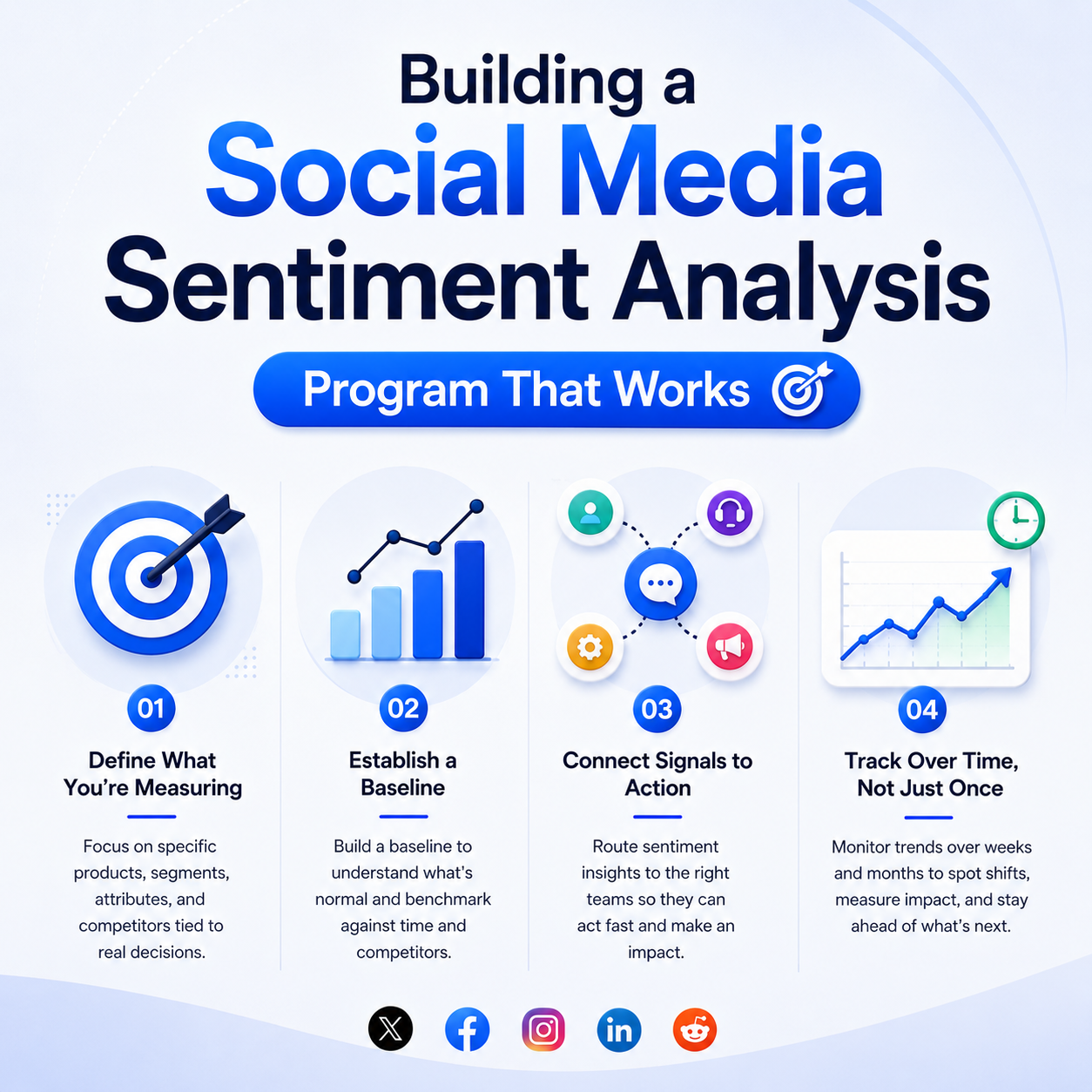
Building a Social Media Sentiment Analysis Program That Works
Having access to AI sentiment analysis is not the same as having a program that produces actionable intelligence. A few things need to be in place.
Define what you're measuring before you measure it. Brand mentions overall is a starting point, not a destination. The intelligence value comes from being specific: sentiment around specific product lines, specific customer segments, specific brand attributes, specific competitive comparisons. Set up the analysis to measure what's actually connected to decisions your team will make.
Establish a baseline before you track change. Sentiment data becomes most useful when you can compare it against something. A current negative sentiment score is hard to interpret without knowing whether that's normal for your category, better or worse than last month, or above or below your competitors. Build the baseline before you need to explain a shift.
Connect sentiment signals to operational workflows. A spike in negative sentiment around customer service that goes into a dashboard nobody checks doesn't help anyone. The programs that produce the most value are the ones where sentiment signals connect directly to the teams that can act on them: product teams seeing feature feedback, service teams seeing service sentiment, marketing teams seeing campaign response. InsignAI is built to make those connections rather than keeping sentiment analysis siloed in a research function.
Track over time, not just at a point. Social media sentiment at a single moment is less useful than sentiment tracked consistently over weeks and months. The trend is where the intelligence lives. Is brand sentiment improving following a product investment? Is a specific theme growing in volume? Is the competitive sentiment gap narrowing or widening? Those questions require longitudinal data, not snapshots.
What InsignAI Brings to Social Media Sentiment Analysis
InsignAI's Market Research LLM is trained on research-grade data, which means it understands customer language at a level of nuance that general-purpose AI tools don't reach.
On social media data specifically, that training produces more accurate classification of the subtle emotional signals that carry the most intelligence value: the quiet disappointment that doesn't read as negative in basic scoring, the comparative language that contains competitive intelligence, the emerging theme that appears in low volume today and high volume three months from now.
The full-stack platform means social media sentiment analysis doesn't sit outside the research workflow. It integrates with survey data, with review data, with qualitative research findings. The picture of customer sentiment that comes out is unified rather than assembled from separate analyses that each tell part of the story.
That integration is what turns sentiment analysis from a monitoring function into a research capability.
Frequently Asked Questions
1. What is social media sentiment analysis and how does it work?
Social media sentiment analysis is the use of AI to read and classify the emotional tone of social media content at scale. It processes mentions, comments, posts, and other social content, identifies whether the sentiment is positive, negative, or neutral, classifies the specific emotion behind the language, extracts the themes the sentiment is directed at, and tracks how all of this changes over time. The AI reads the language the way an experienced researcher would, but across volumes of content that no human team could process manually with consistent accuracy.
2. How is social media sentiment analysis different from basic social media monitoring?
Basic monitoring collects mentions and tracks volume. Sentiment analysis reads the content of those mentions and classifies what they mean. Monitoring tells you that 500 people mentioned your brand this week. Sentiment analysis tells you that 60% of those mentions were positive, that the negative mentions clustered around a specific product issue, that the emotional tone of the negative mentions was primarily frustrated rather than disappointed, and that the volume of that specific theme has been growing for three weeks. One is a data collection function. The other is an intelligence function.
3. How quickly can social media sentiment analysis detect a reputation problem?
With real-time processing, meaningful shifts in sentiment volume or direction can surface within hours of a triggering event. The more useful question is how early a slow-building reputation problem can be detected before it becomes acute. Programs with consistent baseline tracking and trend monitoring can identify emerging negative themes when they're generating modest volume, weeks before they become significant. That early detection window is where the most valuable interventions happen.
4. Can social media sentiment analysis track competitor sentiment as well as brand sentiment?
Yes, and competitive sentiment tracking is one of the highest-value applications. Understanding how customers feel about your brand relative to alternatives, what they say competitors do better, and where your brand sentiment is improving or deteriorating relative to the competitive set gives you strategic context that brand-only tracking misses. Comparative language in social media content is particularly rich with this kind of intelligence.
5. How does InsignAI handle the multilingual nature of global social media data?
InsignAI's Market Research LLM includes multilingual capability built on language-specific models rather than translation-first approaches. Translation before analysis loses register information that carries significant sentiment signal, particularly in languages where emotional expression follows different norms. For brands operating across multiple markets, language-specific models produce more accurate sentiment classification than translation-dependent tools.
6. What volume of social media mentions is needed for meaningful sentiment analysis?
Sentiment classification works accurately at the individual post level regardless of volume. Where volume matters is in the reliability of theme and trend analysis. Detecting that a specific issue is generating 8% of negative mentions requires enough total mentions to distinguish that percentage from random variation. For most brands with meaningful social presence, the volume is sufficient. For smaller brands or niche categories with lower mention volumes, supplementing social data with review data and survey open ends produces a more complete picture.
InsignAI is a full-stack, AI-native market research platform with a dedicated Market Research LLM, built to give brands a real-time read on customer sentiment across every channel that matters.